Key Points
-
Nvidia stock has been falling amid a broader tech sell-off and a report that CEO Jensen Huang may have been a target of Chinese spying.
-
Nvidia has said it expects sales to increase by 70% next year, but a slowdown in the AI sector could hamper that growth.
-
Nvidia stock is now priced attractively — assuming that it meets its guidance.
-
Nvidia (NASDAQ:NVDA) is no longer the most valuable company in the world as of Election Day. Its stock dropped almost 10% in one day, and recent news about CEO Jensen Huang being a possible target of spying sent the stock down even further.
The timing here works out to be just one week before Nvidia is scheduled to report its fiscal 2027 third-quarter earnings on Nov. 17. Is it a buy ahead of that report?
Nvidia is at the center of AI development
A swath of stocks took a hit after the election as numerous Democratic candidates who have promised to push for a slowdown in artificial intelligence (AI) development and the AI data center build-out won their races.
Missed Nvidia in 2009? This Rare Signal Is Flashing Again. In 2009, a “Double Down” signal flashed for a little-known chipmaker called Nvidia. For the first time in years, that same “Total Conviction” signal is flashing for a company 1/100th the size of Nvidia. Continue »
Some AI stocks rose on the news, including Amazon, since the market has been worried about the extraordinary amount of money it is laying out on data centers, and investors welcomed the possibility of it slowing its spending spree.
Nvidia, though, benefits from AI spend, which is why its share price dropped so quickly. It’s the main provider of the graphics processing units (GPUs) that power AI workloads, with up to 95% of the data center GPU market.
Wall Street expects the company’s revenue to increase 91% this year, and Nvidia management has already provided guidance for a 70% sales increase next year. It called that a “supply-constrained outlook.” However, if AI companies are compelled to slow down their build-outs and model development, reduced spending could hurt their chances of making that happen.
What could happen on Nov. 17?
For the fiscal third quarter, which ended Oct. 25, management is guiding for about 90% sales growth, and Wall Street expects $2.47 in earnings per share, up from $1.30 last year. Nvidia tends to easily beat expectations, and the stock generally rises after its earnings reports, but not always.
One area the market will be watching is gross margin. Nvidia is guiding for about 74%, but that’s lower than recent levels.
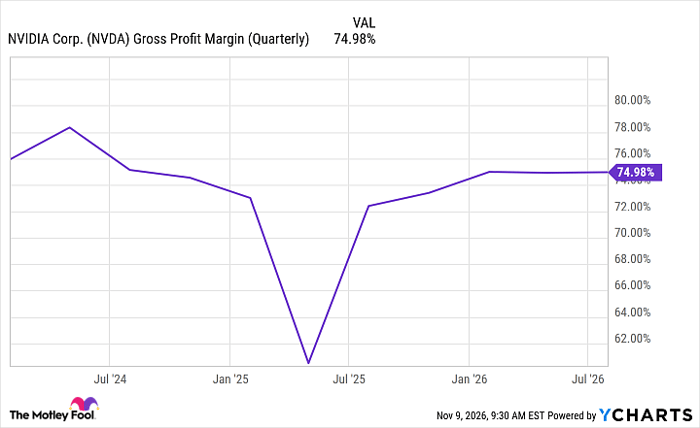
NVDA Gross Profit Margin (Quarterly) data by YCharts
That decline is connected to the rising cost of memory chips, which have been plaguing many AI companies.
At the current price, Nvidia stock trades at a low valuation of 11 times next year’s expected earnings. If management provides updates that expectations for next year haven’t changed for the worse, the stock is likely to rise; a lower P/E ratio usually indicates that the market doesn’t think a company can keep growing earnings at a fast rate. If it can, the P/E ratio should rise.
In other words, the market’s reaction is likely to take more notice of guidance than results, which are usually stellar.
Long term, Nvidia has an excellent business, and its products remain critical components of AI development, which isn’t going away. Now could be a good time for long-term investors to scoop up shares, but expect periods of volatility as AI stocks go through change. And even if you can stomach those ups and downs, at this point, I wouldn’t give Nvidia a prime position in your portfolio.
Should you buy stock in Nvidia right now?
Before you buy stock in Nvidia, consider this:
The Motley Fool Stock Advisor analyst team just identified what they believe are the 10 best stocks for investors to buy now… and Nvidia wasn’t one of them. The 10 stocks that made the cut could produce monster returns in the coming years.
Consider when Netflix made this list on December 17, 2004… if you invested $1,000 at the time of our recommendation, you’d have $344,878!* Or when Nvidia made this list on April 15, 2005… if you invested $1,000 at the time of our recommendation, you’d have $1,097,846!*
Now, it’s worth noting Stock Advisor’s total average return is 852% — a market-crushing outperformance compared to 208% for the S&P 500. Don’t miss the latest top 10 list, available with Stock Advisor, and join an investing community built by individual investors for individual investors.
See the 10 stocks »
*Stock Advisor returns as of November 10, 2026.
Jennifer Saibil has no position in any of the stocks mentioned. The Motley Fool has positions in and recommends Amazon and Nvidia. The Motley Fool has a disclosure policy.