Key Points
-
C3.ai’s sales plummeted after a disruption to its management team last year, but a return to growth might be on the horizon.
-
C3.ai is undergoing an important strategy shift as it works to become an artificial intelligence platform provider for enterprises.
-
C3.ai stock is down 93% from its all-time high, and it probably won’t recover until the company proves it can deliver consistent revenue growth.
-
C3.ai (NYSE: AI) went public in December 2020, and its stock quickly set a record high of $177. It has trended lower ever since, with the downside reaching a crescendo after its founder and chief executive Thomas Siebel announced he was stepping away to deal with health issues last September.
Siebel always played a central role in the sales and customer relationship management processes, so his departure led to a dramatic decline in C3.ai’s revenue. Fortunately, he returned to lead the company in May, and he’s now trying to right the ship.
Missed AI’s “Act 1”? Act 2 Could Be 15x Bigger. Most investors think they missed the AI boat because they didn’t buy Nvidia in 2005. But according to our analysts, we’re only at the end of “Act 1″—the R&D phase. “Act 2” is the global rollout. Continue »
C3.ai stock remains 93% below its all-time high, so could this be a buying opportunity as Siebel puts his turnaround plan in place? The answer might surprise you.
A major strategy shift is under way
Developing AI software from the ground up requires a considerable amount of financial and technical resources, which the average business simply doesn’t have. C3.ai developed a portfolio of turnkey applications covering a range of different industries, and they can be tailored for the specific needs of almost any customer, giving enterprises a more practical way to tap into the power of AI.
However, C3.ai is expanding its addressable market by becoming a platform provider. It launched the C3 Agentic AI Platform last year, which builds a deep understanding of every existing process, relationship, and data set within the enterprise, allowing managers to create powerful agents that can make operational decisions and even automate tasks. In essence, it serves as an intelligent operating system for the enterprise.
The C3 Agentic AI Platform integrates with leading cloud platforms like Microsoft Azure and Amazon Web Services, so it can ingest operational data from across the entire enterprise in real time.
C3.ai’s decision to become a platform provider will be critical to its future success because AI will eventually be at the center of every enterprise, so catering to those deploying just one or two applications was simply the wrong strategy for the long term.
C3.ai’s revenue could fall further in the near term
C3.ai delivered $250.3 million in revenue during its 2026 fiscal year (ended April 30), a 35% decline from the prior year. The company then delivered $52.4 million in revenue during its fiscal 2027 first quarter (ended July 31), a 25% decline from the year-ago period.
The negative results were directly attributable to Siebel’s departure, but better times might be ahead now that he’s leading the company again. According to management’s latest guidance, C3.ai could generate up to $240 million in total revenue during fiscal 2027, which would represent a much smaller decline of 4% compared to fiscal 2026. Plus, Siebel thinks a return to sales growth could be in the cards within the next two quarters.
C3.ai has significantly cut costs across the board to right-size the business in light of its shrinking revenue. It was a necessary step, because the company lost a staggering $470.4 million at the bottom line during fiscal 2026, an increase of 63% from the prior year. It lost a further $92.8 million during the first quarter of fiscal 2027, but that was a 20% improvement from the year-ago period, so things are starting to move in the right direction.
C3.ai stock isn’t necessarily cheap, despite its hefty decline
Shortly after C3.ai went public in 2020, its price-to-sales (P/S) ratio briefly climbed to over 100, which was a ludicrous valuation. For some perspective, the technology-heavy Nasdaq-100 index has a P/S ratio of just 6.3. Investors were expecting rapid revenue growth from C3.ai that simply never came, hence the prolonged decline in its stock over the last six years.
The stock is now trading at a more reasonable P/S ratio of 7.2, which is a steep discount to its average of 14.1 since going public. However, given the company’s revenue is expected to decline in fiscal 2027, its forward P/S ratio is actually slightly higher at 8.3.
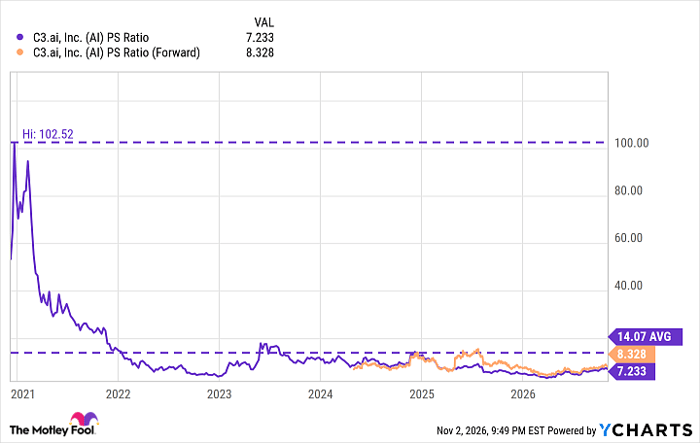
AI PS Ratio data by YCharts
In other words, C3.ai is more expensive when valued against its future potential financial results, whereas a healthy, growing company would actually look cheaper on a forward basis. Shrinking businesses tend to destroy shareholder value over time, which is exactly why investors try to avoid them.
With that said, C3.ai saw a 73% quarter-over-quarter increase in its gross bookings during the third quarter, which typically reflects the value of signed contracts for services that haven’t been delivered yet. Bookings can be a good predictor of future revenue, so this supports Siebel’s expectation of a return to sales growth in the next two quarters.
However, I wouldn’t buy C3.ai stock right now. I would prefer to wait until the company actually does start delivering consistent revenue growth, because any further declines could leave shareholders exposed to steep losses.
Should you buy stock in C3.ai right now?
Before you buy stock in C3.ai, consider this:
The Motley Fool Stock Advisor analyst team just identified what they believe are the 10 best stocks for investors to buy now… and C3.ai wasn’t one of them. The 10 stocks that made the cut could produce monster returns in the coming years.
Consider when Netflix made this list on December 17, 2004… if you invested $1,000 at the time of our recommendation, you’d have $342,020!* Or when Nvidia made this list on April 15, 2005… if you invested $1,000 at the time of our recommendation, you’d have $1,270,017!*
Now, it’s worth noting Stock Advisor’s total average return is 885% — a market-crushing outperformance compared to 208% for the S&P 500. Don’t miss the latest top 10 list, available with Stock Advisor, and join an investing community built by individual investors for individual investors.
See the 10 stocks »
*Stock Advisor returns as of November 5, 2026.
Anthony Di Pizio has no position in any of the stocks mentioned. The Motley Fool has positions in and recommends Amazon and Microsoft. The Motley Fool recommends C3.ai. The Motley Fool has a disclosure policy.