Nvidia (NASDAQ: NVDA) and Palantir (NASDAQ: PLTR) are two of the hottest AI stocks around. Each company is posting strong growth, but I think only one is a buy right now.
By 2027, these two companies will have dramatically different valuations, and that will be the deciding factor between the two.
Missed Nvidia in 2009? This Rare Signal Is Flashing Again. In 2009, a “Double Down” signal flashed for a little-known chipmaker called Nvidia. For the first time in years, that same “Total Conviction” signal is flashing for a company 1/100th the size of Nvidia. Continue »
Nvidia and Palantir are two different styles of AI investments
Nvidia and Palantir operate in two entirely different sectors of AI.
Nvidia is on the infrastructure side, as it makes graphics processing units (GPUs) and various products to support them. GPUs are powerful parallel processors that excel in applications that require maximum computing power. They also can be configured to handle a wide array of computationally heavy workloads. Nvidia’s GPUs are the best available, and they have won a majority of the data center AI accelerator market as a result.
While a lot of AI infrastructure has been built, much more remains to come. Nvidia estimates that the big five hyperscalers will spend nearly $800 billion on capital expenditures this year. For next year, it estimates that figure will rise to $1.3 trillion.
That’s strong growth, and Nvidia has already revealed its own estimated 2027 revenue growth rate: 70%. That’s an impressive figure for a company of Nvidia’s size and makes it a solid investment.
Palantir is on the application side of AI. Its AI-powered data analytics software is becoming widely used by both governments and commercial clients. While Palantir got its start in the government space, its U.S. commercial revenue surpassed its government revenue for the first time in Q3.
In Q3, its revenue rose 96% year over year. That continued a long trend of accelerating revenue growth.
Additionally, Palantir isn’t a growth-at-all-costs company that’s putting profits second. It posted a net income margin of 49%, showcasing its strong profitability.
Accurately predicting next year’s growth isn’t as easy with Palantir. Analysts have consistently underprojected its top line, and with their consensus forecast for revenue to grow only 51% next year, that could be happening again. However, those consensus figures are still the best projections investors have to work with.
Nvidia has no 2027 growth priced in
When it comes to weighing companies’ valuations, I think measuring their stock prices relative to analysts’ earnings estimates for their next year is the best approach. However, we’ll need to tweak how we gauge Palantir due to the analyst community’s poor track record on predicting its results.
Both of them are high-margin, high-growth companies, although Palantir is in an earlier business stage than Nvidia. Furthermore, Palantir’s software business is subscription-based, which should make its revenues more reliable and steady over the long term than Nvidia’s.
As a result, I’ll postulate that at the end of these periods, Nvidia will be trading at 25 times earnings and Palantir will be trading at 40 times earnings.
Now, let’s look at where the stocks are trading based on next year’s earnings estimates.
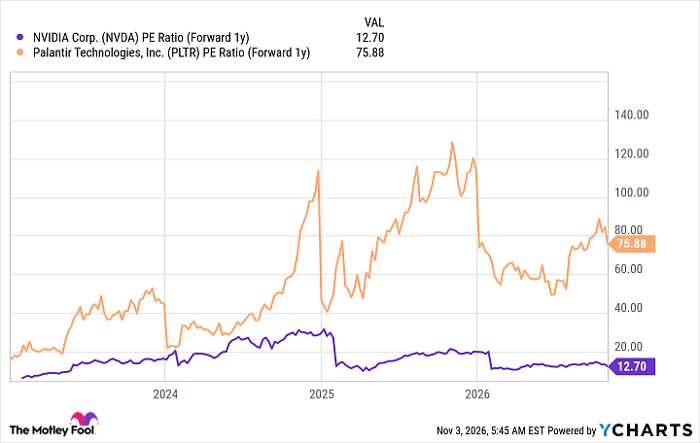
NVDA PE Ratio (Forward 1y) data by YCharts.
Nvidia trades at 12.7 times next year’s expected earnings, suggesting the stock could essentially double to $400 per share if it ends the year trading at 25 times earnings. Palantir’s 75 1-year forward P/E ratio is very high, but remember, analysts have had a tough time projecting its future. So, let’s assume that Palantir’s actual earnings next year will be 50% higher than the consensus. That would drop its valuation to 50 times 1-year forward earnings. That’s still higher than the P/E of 40 that I projected.
As a result, I wouldn’t be surprised if Palantir’s stock stays flat around $180, or even declines to about $150 to become more reasonably valued.
With all that in mind, Nvidia looks like the far better value pick here, and with its 2027 growth forecast already public, there’s little reason to invest in Palantir over Nvidia.
Should you buy stock in Palantir Technologies right now?
Before you buy stock in Palantir Technologies, consider this:
The Motley Fool Stock Advisor analyst team just identified what they believe are the 10 best stocks for investors to buy now… and Palantir Technologies wasn’t one of them. The 10 stocks that made the cut could produce monster returns in the coming years.
Consider when Netflix made this list on December 17, 2004… if you invested $1,000 at the time of our recommendation, you’d have $358,037!* Or when Nvidia made this list on April 15, 2005… if you invested $1,000 at the time of our recommendation, you’d have $1,229,708!*
Now, it’s worth noting Stock Advisor’s total average return is 897% — a market-crushing outperformance compared to 211% for the S&P 500. Don’t miss the latest top 10 list, available with Stock Advisor, and join an investing community built by individual investors for individual investors.
See the 10 stocks »
*Stock Advisor returns as of November 5, 2026.
Keithen Drury has positions in Nvidia. The Motley Fool has positions in and recommends Nvidia and Palantir Technologies. The Motley Fool has a disclosure policy.