Key Points
-
Goldman Sachs is having a record year through the first three quarters.
-
Shares are only up 2.5% YTD, but their performance has been strong.
-
Goldman Sachs is trading at just 12 times earnings.
-
A decade ago, on Nov. 2, 2016, the financial services giant Goldman Sachs Group (NYSE: GS) was trading at about $176 per share with a quarterly dividend of $0.65 per share.
Missed AI’s “Act 1”? Act 2 Could Be 15x Bigger. Most investors think they missed the AI boat because they didn’t buy Nvidia in 2005. But according to our analysts, we’re only at the end of “Act 1″—the R&D phase. “Act 2” is the global rollout. Continue »
As of Nov. 2, 2026, Goldman Sachs stock was trading at $900 per share with a quarterly dividend of $5 per share. It’s quite an impressive trajectory, not just for the price, but also for the dividend.
What would have happened if you invested $10,000 in the financial services stock 10 years ago and reinvested the dividend every quarter? How much would that $10,000 investment be worth today?
A 20% annualized 10-year return
Over the past 10 years, Goldman Sachs has delivered a total return of 518%, with dividends reinvested each quarter. On an average annualized basis, that comes to a 20% return with dividends reinvested.
So, at a 20% annual return, that $10,000 initial investment would grow to about $61,900.
If you contributed $100 per month to that $10,000 investment, you would have about $95,800 today.
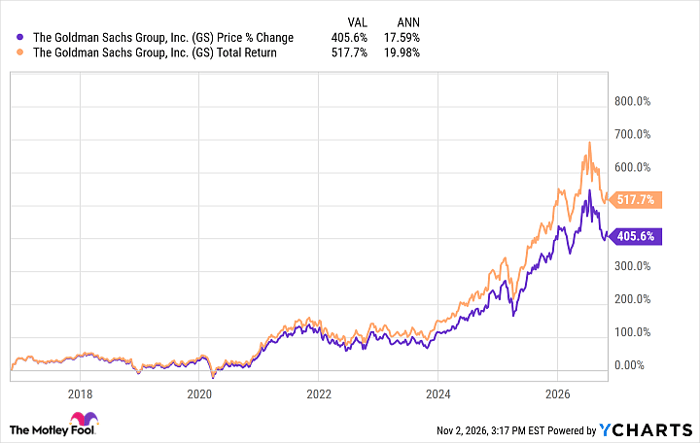
GS data by YCharts
A record year
Goldman Sachs stock is up only about 2% year-to-date and 14% over the past 12 months, below its 10-year average.
But that belies record performance from the leading investment bank. In its recent third-quarter earnings report, Goldman Sachs announced a 23% year-over-year increase in revenue to $18.7 billion, its second-highest quarterly revenue total ever. Net earnings increased 29% to $5.3 billion, while earnings per share skyrocketed 39% to $17.01 per share.
In the first nine months of the year, Goldman Sachs generated a record $56.2 billion in revenue, up 25% from the same period the previous year. Also, earnings through the first three quarters were $17.5 billion, up 40% year over year.
Investment banking and equities trading have fueled Goldman Sachs’ revenue surge. Investment banking fees are up 40% through the first three quarters to $9.5 billion, while equities trading income has jumped 57% to $19.2 billion.
But Goldman Sachs has also seen steady fee income from its asset and wealth management business. It has 35 consecutive quarters of net inflows into this business across equity, fixed income, and alternative investments in both separate accounts and retail investments. In Q3, it had $97 billion in net inflows, contributing to its record $4.1 trillion in assets under supervision.
The steady revenue has allowed it to raise its dividend by 11% in Q3 to $5 per share. It’s the 15th straight year of annual dividend increases. The dividend has a high yield of 2.24% and a low payout ratio of 25%, suggesting Goldman Sachs has ample room to continue boosting its dividend.
The steady asset and wealth management business nicely complements the cyclicality and volatility that comes from its investment banking and trading arms. It’s what has helped make Goldman Sachs one of the top-performing financial stocks, and given its recent trends, I don’t see that ending any time soon. The stock looks particularly attractive as a long-term buy-and-hold right now, given its low price-to-earnings ratio of 12.
Should you buy stock in Goldman Sachs Group right now?
Before you buy stock in Goldman Sachs Group, consider this:
The Motley Fool Stock Advisor analyst team just identified what they believe are the 10 best stocks for investors to buy now… and Goldman Sachs Group wasn’t one of them. The 10 stocks that made the cut could produce monster returns in the coming years.
Consider when Netflix made this list on December 17, 2004… if you invested $1,000 at the time of our recommendation, you’d have $342,020!* Or when Nvidia made this list on April 15, 2005… if you invested $1,000 at the time of our recommendation, you’d have $1,270,017!*
Now, it’s worth noting Stock Advisor’s total average return is 885% — a market-crushing outperformance compared to 208% for the S&P 500. Don’t miss the latest top 10 list, available with Stock Advisor, and join an investing community built by individual investors for individual investors.
See the 10 stocks »
*Stock Advisor returns as of November 5, 2026.
Dave Kovaleski has no position in any of the stocks mentioned. The Motley Fool has positions in and recommends Goldman Sachs Group. The Motley Fool has a disclosure policy.