Key Points
-
Democrats swept both houses of Congress in the midterm elections, potentially putting the Trump bull market at risk.
-
The AI infrastructure build-out faces its toughest test yet, with Democrats likely to home in on AI regulation.
-
History shows that pricey stock markets fare poorly — and putting the spotlight on AI regulation is unlikely to help.
-
The voters have spoken. Democrats flipped several seats in the House of Representatives and the Senate, retaking both houses of Congress. By early January, President Donald Trump will be working with a Democrat-led Congress.
Although the Dow Jones Industrial Average (DJINDICES:^DJI), S&P 500 (SNPINDEX:^GSPC), and Nasdaq Composite (NASDAQINDEX:^IXIC) have delivered outsize average annual returns under President Trump, when compared to most other presidents since the late 1890s, this “blue wave” may threaten the Trump bull market and heighten the odds of a crash.
Missed Nvidia in 2009? This Rare Signal Is Flashing Again. In 2009, a “Double Down” signal flashed for a little-known chipmaker called Nvidia. For the first time in years, that same “Total Conviction” signal is flashing for a company 1/100th the size of Nvidia. Continue »
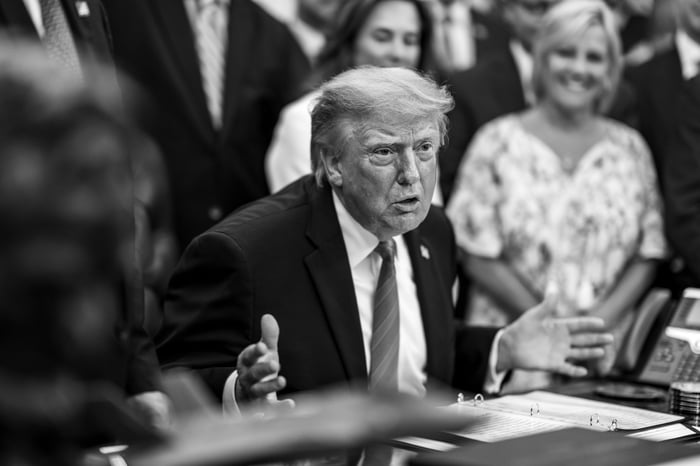
President Trump’s bull market has a new headwind. Image source: Official White House Photo by Daniel Torok.
The Trump bull market now faces a big test
While record S&P 500 share buybacks and initial public offering euphoria have helped power the Dow, S&P 500, and Nasdaq higher, arguably nothing has been a bigger catalyst for the Trump bull market than the artificial intelligence (AI) infrastructure build-out. Empowering software and systems with the tools to make autonomous, split-second decisions is a multitrillion-dollar global opportunity that investors don’t want to miss.
Democrats taking control of both chambers of Congress presents a unique challenge for AI stocks.
On the one hand, President Trump believes that AI regulation should be minimal. Less oversight can, in theory, expedite innovation and provide a serious boost to Wall Street and U.S. gross domestic product.
Most Democratic lawmakers don’t share President Trump’s vision on AI. They’d prefer to limit the pace of data center expansion and ramp up the testing and vetting of large language models/agentic AI solutions.
Image source: Getty Images.
History offers a mixed bag for an AI-driven Trump bull market
The Democratic blue wave by itself is unlikely to be enough to push the Trump bull market over the edge. History shows that the S&P 500 has been higher at the six- and 12-month marks following midterm elections since 1950!
Nevertheless, a Democrat-controlled Congress could put the spotlight on AI regulation. Even though President Trump maintains the power to veto AI legislation from Congress (short of a two-thirds vote from both congressional chambers), highlighting deficiencies for a historically pricey stock market’s No. 1 catalyst probably wouldn’t go over well with investors.
But it’s the historical priciness of the Trump bull market that truly complicates things.
The S&P 500’s Shiller Price-to-Earnings (P/E) Ratio, also known as the Cyclically Adjusted P/E Ratio (CAPE Ratio), has surpassed 30 for only the sixth time in 156 years. The previous five instances in which it exceeded 30 were eventually followed by downturns in the Dow, S&P 500, and/or Nasdaq Composite ranging from 20% to 89%.
In other words, the stock market has repeatedly shown that premium valuations aren’t tolerated over extended time frames. The AI-driven Trump bull market is the second-priciest on record.
Connecting the dots suggests that Democrats putting AI regulation under the microscope may increase the odds of Wall Street’s historically pricey stock market tumbling down the proverbial cliff. Mind you, this in no way guarantees a stock market crash will occur.
But based on what history tells us, a less-friendly environment for AI innovation could spell disaster for an expensive stock market.
Should you buy stock in S&P 500 Index right now?
Before you buy stock in S&P 500 Index, consider this:
The Motley Fool Stock Advisor analyst team just identified what they believe are the 10 best stocks for investors to buy now… and S&P 500 Index wasn’t one of them. The 10 stocks that made the cut could produce monster returns in the coming years.
Consider when Netflix made this list on December 17, 2004… if you invested $1,000 at the time of our recommendation, you’d have $336,195!* Or when Nvidia made this list on April 15, 2005… if you invested $1,000 at the time of our recommendation, you’d have $1,241,567!*
Now, it’s worth noting Stock Advisor’s total average return is 875% — a market-crushing outperformance compared to 208% for the S&P 500. Don’t miss the latest top 10 list, available with Stock Advisor, and join an investing community built by individual investors for individual investors.
See the 10 stocks »
*Stock Advisor returns as of November 4, 2026.
Sean Williams has no position in any of the stocks mentioned. The Motley Fool has no position in any of the stocks mentioned. The Motley Fool has a disclosure policy.