Key Points
-
Robinhood, Charles Schwab, and SoFi offer three distinct routes to a strong 2027.
-
Trading activity, loan losses, and valuation create different risks for each stock.
-
A business can perform well while its shares disappoint if investors have already priced in too much success.
-
What does it take for a financial stock to succeed? Well, it all depends on the stock and the company behind it. A trading platform needs active investors. A brokerage needs a customer base that trusts it with more of their hard-earned savings. A digital bank needs loyal customers who remain loyal after their initial deposit.
Robinhood (NASDAQ: HOOD), Charles Schwab (NYSE: SCHW), and SoFi (NASDAQ: SOFI) each have a path toward a strong 2027. However, how these stocks perform next year will largely depend on what happens in the coming months.
Missed Nvidia in 2009? This Rare Signal Is Flashing Again. In 2009, a “Double Down” signal flashed for a little-known chipmaker called Nvidia. For the first time in years, that same “Total Conviction” signal is flashing for a company 1/100th the size of Nvidia. Continue »
Robinhood stock: Give traders more reasons to stay
Imagine a new investor. Someone excited about increasing their savings through investing. They download the Robinhood app and plan their first trade. Robinhood’s challenge is not only to attract more of these customers, but to keep them active after the excitement of the first few trades wears off.
For example, Robinhood’s third quarter revenue rose 12% from a year ago to $1.42 billion; Gold premium service subscribers rose 34% to 5.2 million. Although rising revenue is important, subscribers show customer commitment. This is a great sign that Robinhood is achieving one of its main aims: turning first-time investors into Robinhood loyalists. Or, as Chief Financial Officer Shiv Verma put it in the latest earnings release, “Customers are trusting us with more of their assets as we deliver on our product roadmap, leading to our highest quarter ever for revenues.”
For 2027 to truly be Robinhood’s year, the company will need to build on this encouraging progress and show that revenue growth isn’t simply dependent on market excitement. Risks for 2027 include a trading slowdown, weakness in the crypto market, and new regulatory measures.
HOOD PS Ratio data by YCharts
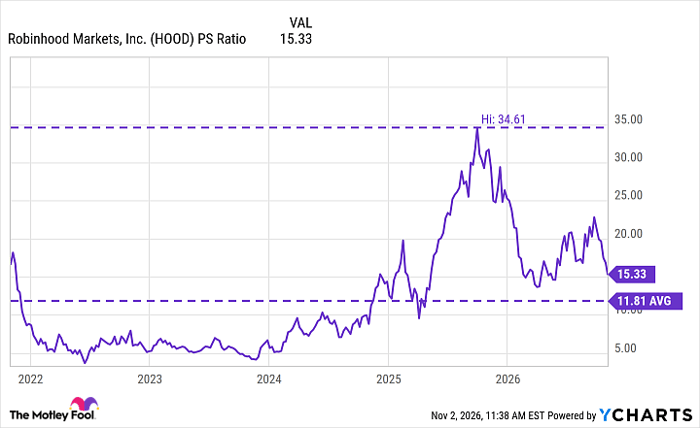
Overall, with a price-to-sales (P/S) ratio of more than 15, Robinhood’s stock remains more highly valued than its five-year average P/S multiple. However, it is far below its five-year high of 35, reached in late 2025. In other words, Robinhood stock might not be cheap, but it’s certainly been more expensive. If the company can build on its business momentum during the next 14 months, 2027 could be a banner year for the company and the stock.
Charles Schwab stock: A larger customer base can produce more profit
To understand Charles Schwab, think of a megamart. Once consumers enter, there are multiple sales opportunities. In the same way that a big-box store might first attract a customer to buy groceries and then sell them a television, Charles Schwab can offer brokerage customers more than just access to trading markets. The company is positioned to parlay its brokerage business into lending, advisory, and other services. In 2027, Schwab’s task is to turn those deeper relationships into higher revenue and greater profits.
For example, the company reported $7.2 billion in third-quarter revenue, up 17% from a year earlier. Net income rose even faster, up 23% to $2.9 billion. As CFO Mike Verdeschi said, “Deeper client engagement continues to broaden and strengthen our revenue model.” In other words, Schwab has found that expanding the ways it serves clients has created more opportunities to earn their business.
Looking ahead to 2027, the plan is simple: Schwab must continue executing its strategy to expand its business and deliver additional services to existing clients, driving up revenue and profitability. The biggest risk to this plan is a market decline, which would reduce the value of customers’ assets and perhaps force customers into more risk-averse assets (e.g., cash), hurting Schwab’s profitability.
SoFi stock: Turn a first account into a financial home
Much like Robinhood and Charles Schwab, SoFi has a similar game plan for 2027. It all comes down to relationship building. A customer might first encounter SoFi through a lending relationship, but the company doesn’t want things to stop there. As we’ve already seen, a larger customer base becomes more valuable not simply because it is larger — it can also become more profitable as the company sells additional products to each existing customer.
Take Chief Executive Officer Anthony Noto’s recent commentary from the company’s third-quarter earnings release: “Our focus is simple. We are adding more members, who are using more products, and generating more revenue per product to create the most value for our shareholders over the long run.” The numbers back up his optimism. SoFi’s products-per-member figure increased to 1.56, up from 1.47 one year ago. Total revenue climbed by 44% to $1.39 billion, and net income soared 73% to $241 million.
Granted, not every new customer relationship results in additional product sales, and SoFi faces risks. In particular, a weakening economy or rising inflation could affect borrowers’ ability to repay loans. That would be bad news for SoFi, as customers missing loan payments would eat into the company’s profits.
The 2027 winners still have to earn their valuations
To recap, each of these three financial stocks could soar in 2027 if they execute their strategic plan and market conditions are favorable. Robinhood’s goal is to gain the loyalty of its fast-growing customer base; Schwab needs to earn more from its existing customer base; and SoFi’s challenge is to build relationships across its business offerings.
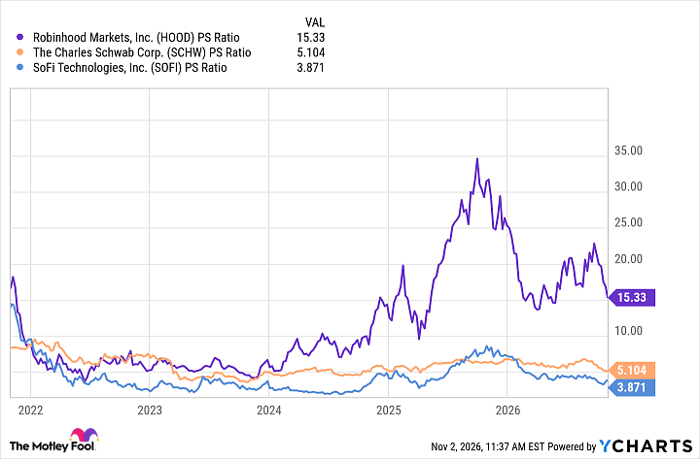
On a valuation basis, SoFi stands out as the most affordable at a 3.9 P/S, while Robinhood’s 15.3 multiple is the highest.
HOOD PS Ratio data by YCharts
Much remains uncertain about 2027. However, each of these three companies has demonstrated solid strategies, built around a proven business model. If they can continue to execute, this trio might top the list of 2027’s best financial stocks.
Should you buy stock in Robinhood Markets right now?
Before you buy stock in Robinhood Markets, consider this:
The Motley Fool Stock Advisor analyst team just identified what they believe are the 10 best stocks for investors to buy now… and Robinhood Markets wasn’t one of them. The 10 stocks that made the cut could produce monster returns in the coming years.
Consider when Netflix made this list on December 17, 2004… if you invested $1,000 at the time of our recommendation, you’d have $336,195!* Or when Nvidia made this list on April 15, 2005… if you invested $1,000 at the time of our recommendation, you’d have $1,241,567!*
Now, it’s worth noting Stock Advisor’s total average return is 875% — a market-crushing outperformance compared to 208% for the S&P 500. Don’t miss the latest top 10 list, available with Stock Advisor, and join an investing community built by individual investors for individual investors.
See the 10 stocks »
*Stock Advisor returns as of November 4, 2026.
Charles Schwab is an advertising partner of Motley Fool Money. Jake Lerch has no position in any of the stocks mentioned. The Motley Fool recommends Charles Schwab and Robinhood Markets and recommends the following options: short September 2026 $95 calls on Charles Schwab. The Motley Fool has a disclosure policy.