In early June, Nvidia CEO Jensen Huang called Marvell Technology (NASDAQ: MRVL) the next trillion-dollar company. Huang explained that Marvell’s connectivity solutions are essential for coordinating large clusters of processors powering artificial intelligence (AI) systems.
Wall Street initially embraced this optimism. Marvell shares surged to about $291 on June 2 and reached a record closing price of nearly $316 just two days later. However, enthusiasm around Marvell seems to have evaporated. As of Nov. 2, Marvell stock traded at $171, representing a decline of 46% from its peak.
Missed Nvidia in 2009? This Rare Signal Is Flashing Again. In 2009, a “Double Down” signal flashed for a little-known chipmaker called Nvidia. For the first time in years, that same “Total Conviction” signal is flashing for a company 1/100th the size of Nvidia. Continue »
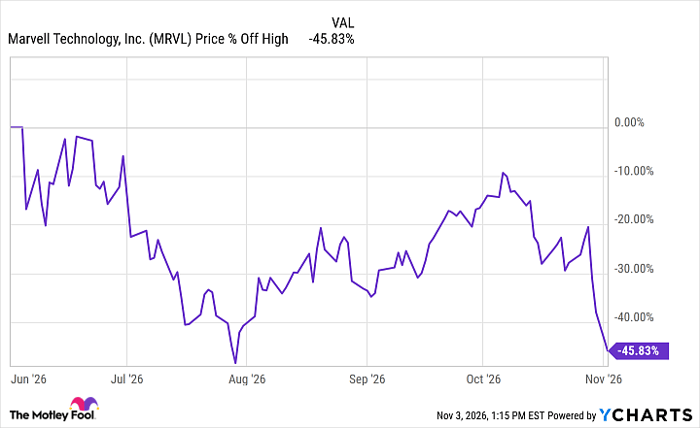
MRVL data by YCharts
The sell-off follows Marvell’s announcement that it is acquiring optical networking specialist Lumentum (NASDAQ: LITE) in a $115 billion deal. Let’s unpack why Wall Street is reacting so negatively to this news and assess whether investors are overlooking the long-term opportunity.
Why Jensen Huang sees trillion-dollar potential in Marvell
Marvell is quietly becoming an important supplier to the AI infrastructure supercycle. The company’s custom application-specific integrated circuits (ASICs) allow hyperscalers to build processors optimized for particular training and inference workloads, while its networking and connectivity products help transfer information between chips and servers.
Nvidia recognized this opportunity early on, announcing a $2 billion investment in Marvell and a partnership involving its NVLink Fusion platform. The collaboration allows AI developers to combine custom silicon designed by Marvell with Nvidia’s broader computing and networking architectures.
Why the Lumentum acquisition sent Marvell stock plunging
On Nov. 2, Marvell announced an agreement to acquire Lumentum in an all-stock transaction carrying an implied enterprise value of approximately $115 billion. The acquisition values Lumentum at approximately $1,132 per share, representing a 24% premium to its closing price on Oct. 28, right as speculation about the deal surfaced.
The transaction’s structure is important to understand. Rather than paying cash or taking on debt to finance the acquisition, Marvell will issue 4.5 new shares for every outstanding Lumentum share. Following the transaction, Marvell shareholders will own 67% of the combined company while Lumentum shareholders will control the remaining 33%.
This means Marvell’s investors are effectively surrendering one-third of the combined company’s ownership to acquire Lumentum. That dilution explains Wall Street’s negative reaction. However, since the agreement uses a fixed exchange ratio rather than a guaranteed cash price, the value Lumentum shareholders ultimately receive will fluctuate with Marvell’s stock price. In other words, the acquisition’s headline valuation isn’t necessarily the price Marvell will actually pay.
Is Wall Street overlooking Marvell’s long-term potential?
Despite the dilution, I think there are some meaningful benefits to this deal. Marvell’s portfolio includes digital signal processors (DSPs), networking chips, and connectivity solutions that enable data to move through AI systems. Lumentum complements those capabilities with lasers and optical components used to transmit information at low latencies. Combining these solutions allows Marvell to offer customers a more complete optical connectivity suite.
Management expects the transaction to generate more than $1 billion in annual run rate cost synergies and become accretive to adjusted earnings per share (EPS) during the first year post-close.
Although the market’s reaction has been severe so far, investors should not lose sight of Marvell’s long-term potential. During its investor day last month, management estimated that its total addressable market (TAM) could reach $400 billion by calendar 2030. Following the proposed Lumentum acquisition, the combined company’s addressable market is expected to expand to $550 billion.
Another important development involves Alphabet. In August, Marvell disclosed an agreement to develop custom semiconductors supporting Google’s Tensor Processing Unit (TPU) ecosystem. As part of the arrangement, Google received warrants to purchase 59 million Marvell shares at $206.58 each.
I think the agreements with Google and Nvidia reinforce Marvell’s rising position as an important partner to some of the world’s largest AI infrastructure customers. Ultimately, Marvell’s acquisition of Lumentum could strengthen its competitive position by bridging optical components and semiconductor design under one roof.
Nevertheless, the market seems to be focusing on what existing shareholders need to give up in the short term. Huang’s trillion-dollar prediction remains ambitious, but the strategic rationale behind his enthusiasm hasn’t disappeared just because Marvell’s stock price is falling.
For investors willing to tolerate volatility in the near term and wait a few years for the acquisition’s benefits to materialize in both revenue and profit, Marvell’s sell-off could represent an attractive opportunity to buy the dip.
Should you buy stock in Marvell Technology right now?
Before you buy stock in Marvell Technology, consider this:
The Motley Fool Stock Advisor analyst team just identified what they believe are the 10 best stocks for investors to buy now… and Marvell Technology wasn’t one of them. The 10 stocks that made the cut could produce monster returns in the coming years.
Consider when Netflix made this list on December 17, 2004… if you invested $1,000 at the time of our recommendation, you’d have $342,020!* Or when Nvidia made this list on April 15, 2005… if you invested $1,000 at the time of our recommendation, you’d have $1,270,017!*
Now, it’s worth noting Stock Advisor’s total average return is 885% — a market-crushing outperformance compared to 208% for the S&P 500. Don’t miss the latest top 10 list, available with Stock Advisor, and join an investing community built by individual investors for individual investors.
See the 10 stocks »
*Stock Advisor returns as of November 4, 2026.
Adam Spatacco has positions in Alphabet and Nvidia. The Motley Fool has positions in and recommends Alphabet, Lumentum, Marvell Technology, and Nvidia. The Motley Fool has a disclosure policy.