Key Points
-
SCHD’s annual dividend per share rose about 49% from 2019 to 2022, a span that included the 2020 crash and the 2022 bear market.
-
While its dividend payments continued rising, its share price fell both times.
-
Dividend growth has cooled recently, and that’s the number I’d track if the market falls again.
-
With the market on edge these days, especially heading into Friday’s jobs report, a question keeps nagging income investors: What will happen to my dividends if stocks crash?
The Schwab U.S. Dividend Equity ETF (NYSEMKT:SCHD) has already endured two bear markets since its inception in 2011. The S&P 500 fell about 34% in early 2020 and again by over 24% in 2022. Yet SCHD’s annual dividends per share rose about 49% from 2019 to 2022, from a split-adjusted $0.57 to $0.85 per share.
Missed Nvidia in 2009? This Rare Signal Is Flashing Again. In 2009, a “Double Down” signal flashed for a little-known chipmaker called Nvidia. For the first time in years, that same “Total Conviction” signal is flashing for a company 1/100th the size of Nvidia. Continue »
I own the ETF and added to my position last week, so I wanted to know what that record can — and can’t — tell us. Here’s a recent catch in its dividend record that I’m watching very closely.
Image source: Getty Images.
What SCHD’s dividend did in 2020 and 2022
Adjusted for the ETF’s 2024 3-for-1 share split, the Schwab U.S. Dividend Equity ETF paid roughly $0.57 per share in 2019, $0.68 in 2020, $0.75 in 2021, and $0.85 in 2022, according to the distribution history on its website. That’s an increase of 17.6% in the year of the COVID crash and 13.9% in the year of the bear market.
However, while the dividend went up both times, SCHD’s share price didn’t escape the downdraft. Its worst three-month return was -21.6% in early 2020. It also declined during the 2022 bear market.
One caution when you look at the payout history is that SCHD’s quarterly payments swing wildly:
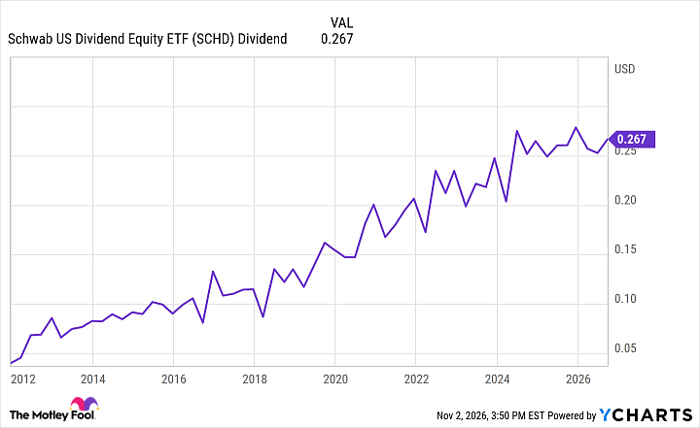
SCHD Dividend data by YCharts
So, while the payout grew in both 2020 and 2022, it wasn’t a straight line.
Here’s the catch
SCHD’s dividend didn’t just grow through those downturns. It grew fast. Overall, dividends per share have grown at a 9% compound annual rate from 2020 through 2025. However, over the past 12 months, the payout has only increased by about 2% compared to the prior year.
That’s a sharp slowdown, and it matters because the case for a dividend growth ETF rests on that growth. I don’t know yet whether it’s a blip or a trend. If the pace stays near 2%, the resilience we saw in 2020 and 2022 is worth less than it looks.
It’s also worth noting that no two crashes are the same. For example, the 2020 crash was brutal but brief, and the 2022 decline was driven by rising inflation and interest rates. So, a deeper, longer earnings recession would be a tougher test for the dividend.
Why the payout held up during bear markets
The slowdown doesn’t erase why SCHD’s payout held up in the past. The ETF tracks the Dow Jones U.S. Dividend 100 Index, which screens for yield, five-year dividend growth, and financial strength. The index also revamps its holdings once a year, swapping out companies that no longer measure up.
The ETF holds many large companies with long histories of dividend growth. Its top holdings include Procter & Gamble and Coca-Cola. Big, established businesses like these tend to have the cash flow and financial strength to keep paying through a downturn. Procter & Gamble has raised its dividend for 70 straight years, while Coca-Cola is up to 64 straight years. They’re both Dividend Kings, companies with 50 or more years of annual dividend increases.
What could happen to SCHD if there’s another crash?
If the last two crashes are any indication, SCHD’s dividend will likely keep rising while its share price would probably decline during a market slump. Depending on the catalyst, it might decline less than the S&P 500, due to the more defensive nature of its holdings, its strong dividend income, and its current valuation (at 18.2 times earnings, it’s cheaper than the S&P 500 at 23.6 times earnings).
That’s not a bad combination if you’re collecting dividends. SCHD currently has a trailing 12-month yield of more than 3%. If its share price declines while its payout continues to rise, investors could lock in an even higher yield on newly purchased shares, enabling them to generate even more dividend income in the future.
What I’m watching
I’m not selling SCHD because a stock market crash could be coming, as the ETF’s history gives me some comfort. It has historically continued paying a higher dividend, even though its share price has taken a hit. However, the catch is that dividend growth has significantly slowed more recently despite a solid economic environment. That’s why I’ll be watching its next payout announcement in December to see if the slowdown is just a temporary blip or something more concerning.
Should you buy stock in Schwab U.S. Dividend Equity ETF right now?
Before you buy stock in Schwab U.S. Dividend Equity ETF, consider this:
The Motley Fool Stock Advisor analyst team just identified what they believe are the 10 best stocks for investors to buy now… and Schwab U.S. Dividend Equity ETF wasn’t one of them. The 10 stocks that made the cut could produce monster returns in the coming years.
Consider when Netflix made this list on December 17, 2004… if you invested $1,000 at the time of our recommendation, you’d have $336,195!* Or when Nvidia made this list on April 15, 2005… if you invested $1,000 at the time of our recommendation, you’d have $1,241,567!*
Now, it’s worth noting Stock Advisor’s total average return is 875% — a market-crushing outperformance compared to 208% for the S&P 500. Don’t miss the latest top 10 list, available with Stock Advisor, and join an investing community built by individual investors for individual investors.
See the 10 stocks »
*Stock Advisor returns as of November 4, 2026.
Matt DiLallo has positions in Coca-Cola, Procter & Gamble, and Schwab U.S. Dividend Equity ETF. The Motley Fool has no position in any of the stocks mentioned. The Motley Fool has a disclosure policy.