Key Points
-
A bond sell-off lowers prices and raises yields available to new buyers.
-
Higher starting yields have historically supported better longer-term bond returns.
-
These funds serve different purposes; owning all three is not automatically the best allocation.
-
Watching a bond ETF lose value can be concerning. After all, aren’t bonds supposed to be every portfolio’s safe harbor? Yet bond sell-offs can offer opportunities for those willing to take the long view. When bond prices decline, bond yields rise, meaning that the same market now offers more income for the money invested.
Granted, that doesn’t erase losses or guarantee future returns, but it can improve the starting point for an investor with a long time horizon. Let’s cover three bond ETFs that each offer a unique way to approach that opportunity, and see how choosing between them starts with understanding what you want your bonds to do.
Missed Nvidia in 2009? This Rare Signal Is Flashing Again. In 2009, a “Double Down” signal flashed for a little-known chipmaker called Nvidia. For the first time in years, that same “Total Conviction” signal is flashing for a company 1/100th the size of Nvidia. Continue »
Why higher bond yields can improve long-term returns
To understand the present moment, we must first understand the relationship between bond prices and bond yields. In short, bond prices and yields move in opposite directions. Strictly speaking, they are inversely related. That is, if a bond’s price declines, its yield rises, and vice versa. Therefore, as bond prices have fallen this year, their yields have increased. Take the 10-year Treasury note, for example. Its price has declined by roughly 6% to 7%, while its yield has jumped from 4.19% to around 5.01%.
Moreover, higher yields make bond ETFs more attractive to income-oriented investors. There’s some evidence supporting a link between higher yields and subsequent multi-year returns. In other words, higher yields can be a buying signal. Indeed, a Capital Group report noted that when the broad U.S. aggregate bond index started with yields between 4% and 6%, the average subsequent five-year annualized return was 5.5%.
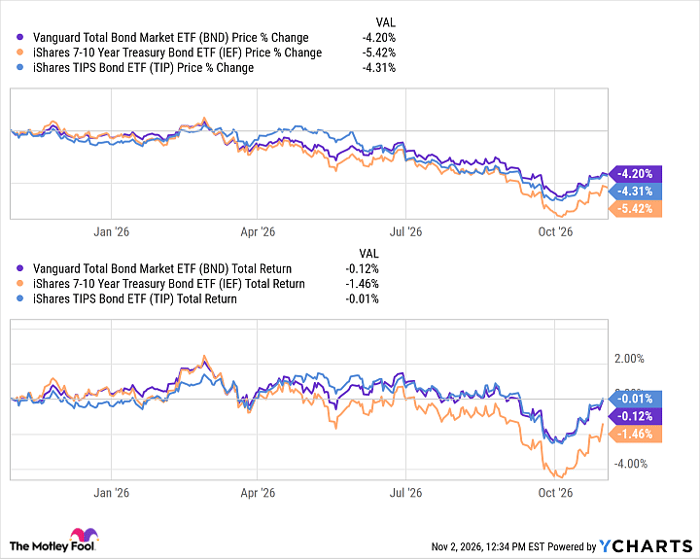
BND data by YCharts
Vanguard Total Bond Market ETF: A simple foundation for a bond portfolio
The Vanguard Total Bond Market ETF (NASDAQ: BND) offers investors a wide selection of bonds, including U.S. government, corporate, and mortgage-backed debt. It holds thousands of individual bonds, so investors don’t have to do their own research. It also has a very low expense ratio of 0.03%, meaning someone who invests $10,000 should expect to pay only $3 in annual fees. As for current yield, the fund’s latest yield, as of Oct. 29, 2026, is around 4.13%.
BND’s broad exposure makes it ideal for investors seeking a diverse bond fund that captures exposure from many different fixed-income issuers. Its low fees are a selling point, but its moderate yield may leave some income-oriented investors looking for more.
For the investment to work, bond prices need to stabilize, consistent with recent price action. In addition, the credit quality of the underlying issuers must remain strong to ensure steady cash flow for the fund. On the other hand, the main risk of owning BND shares is that interest rates begin to rise again. Steadily rising interest rates would push the fund’s price lower.
iShares 7–10 Year Treasury Bond ETF: Treasury income with meaningful price swings
The iShares 7–10 Year Treasury Bond ETF (NASDAQ: IEF) is a Treasury bond fund. Rather than casting a wide net, the fund holds only U.S. Treasury debt with maturities of around 7 to 10 years. As such, the fund is sensitive to both short-term catalysts (e.g., Federal Reserve rate decisions) and market variables (e.g., economic growth and inflation). The fund boasts a strong 4.99% yield, as of Oct. 29. It also carries a low annual expense ratio of 0.15%.
IEF is a fund tailor-made for investors seeking moderate cash flow with almost no credit risk. Since the fund holds only U.S. Treasury debt, investors are only exposed to the credit risk of one issuer: the U.S. Treasury. Similar to BND, IEF will perform well if interest rates stabilize. By contrast, rising interest rates, triggered by inflation or by the Federal Reserve, will hurt its returns.
TIP: Inflation protection comes with a catch
For investors concerned about inflation, the iShares TIPS Bond ETF (NYSEMKT: TIP) could be the answer. The fund owns Treasury inflation-protected bonds (TIPS). The principal on these bonds adjusts as inflation rises, providing some protection against inflation’s eroding effects.
Turning to fees, the fund has an annual expense ratio of 0.18%, making it the most expensive of the three funds highlighted. As of Oct. 29, it yields 5.56%. However, its inflation-adjustment mechanism affects this yield, so readers shouldn’t assume it’s higher than IEF or BND.
TIP is best for fixed-income investors seeking moderate yield, little to no credit risk, and a strong hedge against inflation.
Choose the bond ETF that fits the job
The right fund largely depends on who is asking. Many novice fixed-income investors may prefer BND for its ultra-low cost and broad-based holdings. Those seeking higher yield without taking on significant credit risk may prefer IEF. Finally, investors particularly interested in hedging against inflation may choose TIP. Ultimately, investors should match the fund to the multi-year plan that best suits them.
Should you buy stock in Vanguard Total Bond Market ETF right now?
Before you buy stock in Vanguard Total Bond Market ETF, consider this:
The Motley Fool Stock Advisor analyst team just identified what they believe are the 10 best stocks for investors to buy now… and Vanguard Total Bond Market ETF wasn’t one of them. The 10 stocks that made the cut could produce monster returns in the coming years.
Consider when Netflix made this list on December 17, 2004… if you invested $1,000 at the time of our recommendation, you’d have $342,020!* Or when Nvidia made this list on April 15, 2005… if you invested $1,000 at the time of our recommendation, you’d have $1,270,017!*
Now, it’s worth noting Stock Advisor’s total average return is 885% — a market-crushing outperformance compared to 208% for the S&P 500. Don’t miss the latest top 10 list, available with Stock Advisor, and join an investing community built by individual investors for individual investors.
See the 10 stocks »
*Stock Advisor returns as of November 4, 2026.
Jake Lerch has no position in any of the stocks mentioned. The Motley Fool has positions in and recommends Vanguard Total Bond Market ETF. The Motley Fool has a disclosure policy.