Key Points
-
Americans from across the country will head to the polls or mail in their ballots on Nov. 3.
-
Wall Street and investors favor predictability above all else.
-
U.S. total debt and the artificial intelligence (AI) regulatory landscape may be sticking points for the Trump bull market under a split Congress.
-
Next week, on Nov. 3, Americans from across our great country will head to the polls or mail in the ballots and make their voices heard. While President Donald Trump still has a little over two years left in his second nonconsecutive term, the makeup of Congress could look much different come January 2027.
To date, the Dow Jones Industrial Average (DJINDICES:^DJI), S&P 500 (SNPINDEX:^GSPC), and Nasdaq Composite (NASDAQINDEX:^IXIC) have flourished under Trump. But four catalysts stemming from the midterm elections threaten to push the Trump bull market over the edge.
Missed AI’s “Act 1”? Act 2 Could Be 15x Bigger. Most investors think they missed the AI boat because they didn’t buy Nvidia in 2005. But according to our analysts, we’re only at the end of “Act 1″—the R&D phase. “Act 2” is the global rollout. Continue »
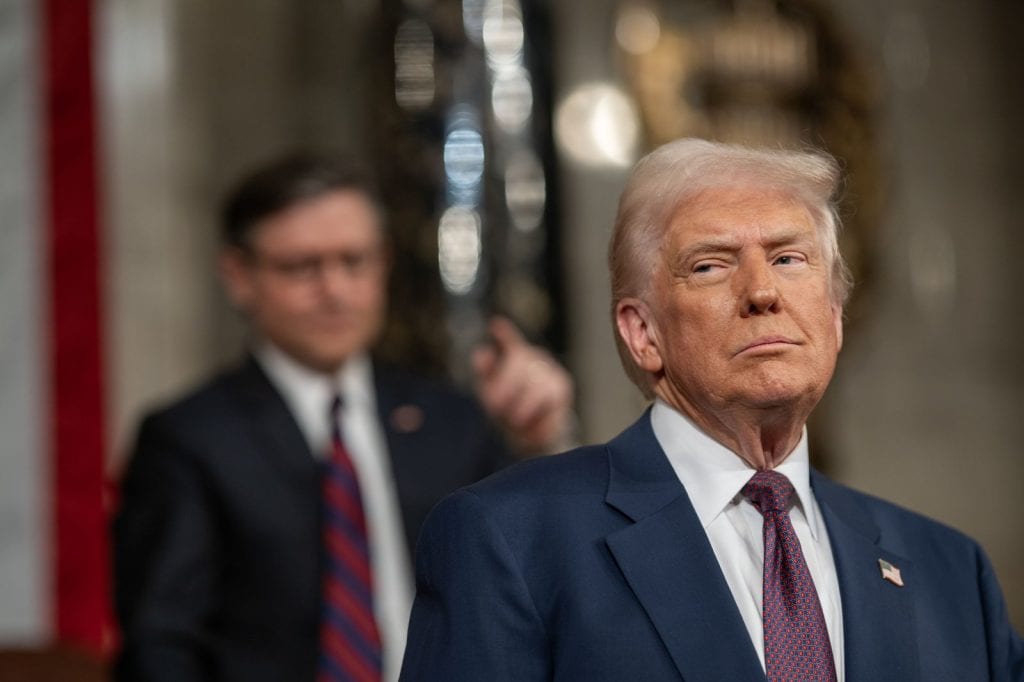
Congress could look a lot different under President Trump come January 2027. Image source: Official White House Photo.
Unexpected results
Last week, Brazil’s Ibovespa Index lost nearly 14% in one day after a surprise presidential election outcome. While a single-session move of this magnitude would be almost impossible based on U.S. midterm election results, it demonstrates how important predictability is to investors.
According to online retirement planning site Retirement Researcher, which examined the average annual return of the S&P 500 across four political scenarios, a Republican president overseeing a divided Congress produced the lowest average annual return (7.33%).
Even though this is a less-than-ideal historical return, investors overwhelmingly expect Democrats to retake one or both houses of Congress on Nov. 3. If this projection doesn’t come to fruition, a sizable move could be seen in the Dow, S&P 500, and Nasdaq Composite.
Debt-ceiling gridlock
If midterm elections go as prediction markets expect, President Trump will be working with a divided Congress beginning in early January 2027.
On the one hand, a split Congress effectively eliminates major tax and spending legislation being signed into law. This should make the personal and corporate income tax environment highly predictable through the end of Donald Trump’s term.
Conversely, a divided Congress sets the stock market up for debt-ceiling drama. The debt ceiling is estimated to be reached by early to mid-2027. Given the differing spending agendas of America’s two major political parties, avoiding a lengthy government shutdown that damages the U.S. economy and Wall Street may prove challenging.

Image source: Getty Images.
Runaway national debt and federal deficits
Building off the previous point, midterm elections may exacerbate America’s perilous debt situation.
In mid-August, U.S. total debt surpassed $40 trillion for the first time, fueled by jaw-dropping federal deficits of $1.38 trillion to $3.13 trillion over the last seven years. Long-duration Treasury bond yields (10- and 30-year yields) have soared to nearly quarter-century highs as total debt hits new records.
A divided Congress is unlikely to make much, if any, headway in reducing annual federal deficits. This suggests persistently high long-duration bond yields are here to stay, meaning higher debt-servicing costs for the U.S. government and costlier borrowing rates for corporate America.
Tougher talk about AI regulation
Last but certainly not least, a Democrat-controlled House and/or Senate would likely push for tougher artificial intelligence (AI) regulations.
The AI infrastructure build-out has thrived, in part, due to the Trump administration’s hands-off regulatory approach. Most congressional Democrats favor limiting data centers and instilling stronger AI safeguards.
Keep in mind that President Trump would still hold veto power, which could only be overridden by a two-thirds vote in the House and the Senate. Nevertheless, increased regulatory scrutiny for the Trump bull market’s leading catalyst, and amid a historically expensive stock market, could send equities over the edge.
While a stock market crash is far from guaranteed, the odds of one occurring are climbing.
Should you buy stock in S&P 500 Index right now?
Before you buy stock in S&P 500 Index, consider this:
The Motley Fool Stock Advisor analyst team just identified what they believe are the 10 best stocks for investors to buy now… and S&P 500 Index wasn’t one of them. The 10 stocks that made the cut could produce monster returns in the coming years.
Consider when Netflix made this list on December 17, 2004… if you invested $1,000 at the time of our recommendation, you’d have $334,308!* Or when Nvidia made this list on April 15, 2005… if you invested $1,000 at the time of our recommendation, you’d have $1,323,413!*
Now, it’s worth noting Stock Advisor’s total average return is 897% — a market-crushing outperformance compared to 213% for the S&P 500. Don’t miss the latest top 10 list, available with Stock Advisor, and join an investing community built by individual investors for individual investors.
See the 10 stocks »
*Stock Advisor returns as of October 30, 2026.
Sean Williams has no position in any of the stocks mentioned. The Motley Fool has no position in any of the stocks mentioned. The Motley Fool has a disclosure policy.