Key Points
-
Amazon delivered strong growth on the top and bottom lines in the third quarter, but the stock still fell.
-
CEO Andy Jassy predicted the company could have two businesses with a trillion dollars in revenue in the next decade.
-
Considering that potential, Amazon looks significantly undervalued.
-
Like Meta, Microsoft, and Alphabet, Amazon (NASDAQ:AMZN) stock headed lower after its earnings report, down 7% in after-hours trading on Thursday.
Skepticism about massive capital expenditures on AI has spread across big tech stocks, and Amazon became the latest victim. The company didn’t adjust its forecast of $220 billion in capex for the year, but it did report a $42 billion loss in free cash flow for the previous four quarters, showing the build-out is already costing it.
Missed Nvidia in 2009? This Rare Signal Is Flashing Again. In 2009, a “Double Down” signal flashed for a little-known chipmaker called Nvidia. For the first time in years, that same “Total Conviction” signal is flashing for a company 1/100th the size of Nvidia. Continue »
Amazon reported 12% revenue growth to $201.9 billion in the third quarter, slightly below estimates of $202.3 billion. Adjusting for foreign exchange and the shift in Prime Day from Q3 to Q2, revenue would have been up 17%.
Bottom-line growth was also strong, with operating income up 61% to $28.1 billion. Equity gains often distort Amazon’s earnings per share, so operating income is a better metric to evaluate its profits.
Those numbers weren’t enough to please investors, but the tech giant did share a longer-term prediction that investors will want to hear.
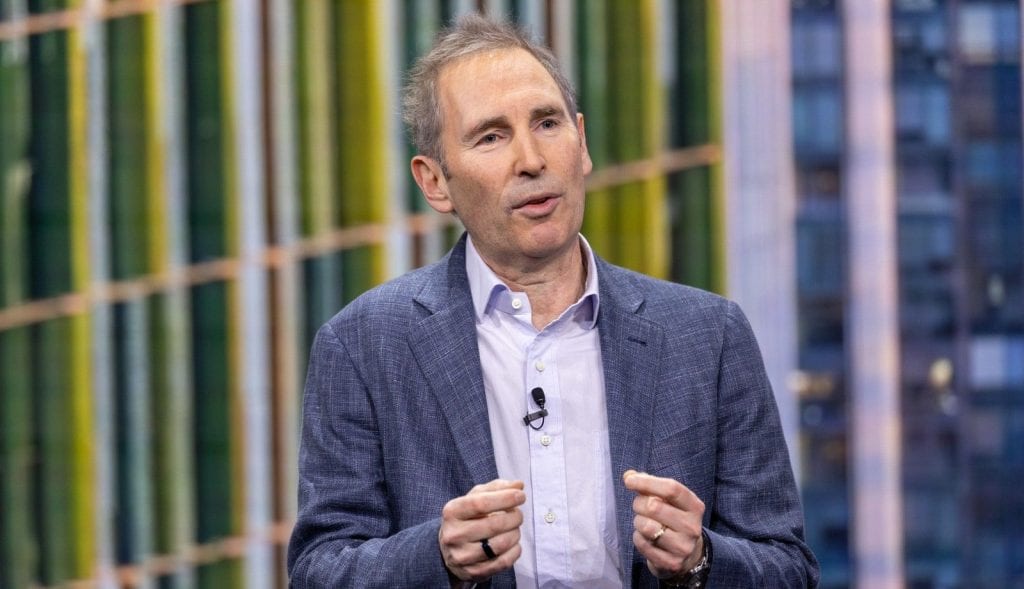
Andy Jassy. Image source: Amazon.
Two trillion-dollar businesses
Amazon could become the first company to hit a trillion dollars in annual revenue as soon as next year, but CEO Andy Jassy doesn’t have any plans of slowing down.
In the earnings release, he told investors, “There has never been a trillion-dollar revenue business, and we may have two of them in the next 5-10 years.”
Of course, Jassy is referring to Amazon’s e-commerce business and its cloud infrastructure business, Amazon Web Services. By revenue, e-commerce is the much larger of the two businesses and will almost certainly hit $1 trillion in the next five to ten years. In the last four quarters, the company generated $638.3 billion from its North America and International segments, which comprise the e-commerce segment, and that business has been growing at a low-teens rate over the last few years. At a 10% growth rate, it would reach $1 trillion in revenue in less than five years.
AWS, on the other hand, has brought in $165.2 billion in revenue in the last four quarters, meaning it would have to grow by six times to reach $1 trillion. However, the company expects at least 40% revenue growth in both 2027 and 2028, which would bring its revenue to about $330 billion two years from now. From there, AWS could grow by 20% a year over the next six years and reach $1 trillion in revenue.
Like its peers, Amazon’s cloud unit is clearly getting a strong tailwind from AI, which gives the company confidence to forecast growth of 40% over the next two years. From there, it could continue to deliver strong growth; the 20% growth rate above is just illustrative of what it would take for the company to get to $1 trillion.
What it means for investors
For years, Amazon was a high-priced stock, but that’s no longer the case. After falling nearly 8% in the after-hours session, the stock is set to open Friday morning at roughly 20 times operating income. Despite concerns about its capex, this is still a business that is the world’s largest by revenue and is comfortably growing revenue in the double digits annually. Its two major businesses, e-commerce and AWS, have substantial competitive advantages, meaning Amazon is unlikely to be knocked from its perch.
As Jassy predicted, the company could very well have two trillion-dollar businesses in the next decade, as Amazon is the global leader in two massive industries, online retail and cloud computing. For that kind of stock, investors are getting a great price after the post-earnings sell-off.
Should you buy stock in Amazon right now?
Before you buy stock in Amazon, consider this:
The Motley Fool Stock Advisor analyst team just identified what they believe are the 10 best stocks for investors to buy now… and Amazon wasn’t one of them. The 10 stocks that made the cut could produce monster returns in the coming years.
Consider when Netflix made this list on December 17, 2004… if you invested $1,000 at the time of our recommendation, you’d have $334,308!* Or when Nvidia made this list on April 15, 2005… if you invested $1,000 at the time of our recommendation, you’d have $1,323,413!*
Now, it’s worth noting Stock Advisor’s total average return is 897% — a market-crushing outperformance compared to 213% for the S&P 500. Don’t miss the latest top 10 list, available with Stock Advisor, and join an investing community built by individual investors for individual investors.
See the 10 stocks »
*Stock Advisor returns as of October 30, 2026.
Jeremy Bowman has positions in Amazon and Meta Platforms. The Motley Fool has positions in and recommends Alphabet, Amazon, Meta Platforms, and Microsoft. The Motley Fool has a disclosure policy.