Key Points
-
Although the Dow Jones Industrial Average, S&P 500, and Nasdaq Composite have delivered outsize returns under Donald Trump, not all of his policies have been well-received by Wall Street.
-
Tariffs have been foundational to Trump’s presidency.
-
Not only are the president’s tariffs raising consumer prices, according to New York Federal Reserve economists, but they’re also having a lasting negative impact on select public companies.
-
Trumpflation could do a real number on a historically pricey stock market.
-
From a purely statistical standpoint, Wall Street has enjoyed having President Donald Trump in the White House. Even accounting for a few periods of historic volatility (e.g., the COVID-19 crash in February-March 2020 and the tariff tantrum of April 2025), the average annual return of the Dow Jones Industrial Average (DJINDICES:^DJI), S&P 500 (SNPINDEX:^GSPC), and Nasdaq Composite (NASDAQINDEX:^IXIC) has been higher under Trump than under most presidents since the late 1890s.
However, this doesn’t mean that all of the president’s policies are necessarily well-received on Wall Street. For example, Trumpflation (inflation specifically driven by Donald Trump’s policies) is a genuine threat to the artificial intelligence (AI)-driven bull market.
Missed AI’s “Act 1”? Act 2 Could Be 15x Bigger. Most investors think they missed the AI boat because they didn’t buy Nvidia in 2005. But according to our analysts, we’re only at the end of “Act 1″—the R&D phase. “Act 2” is the global rollout. Continue »
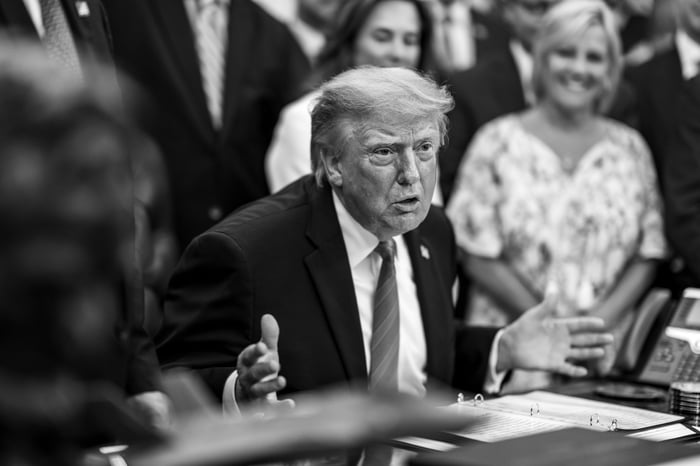
President Trump’s tariffs are doing more harm than good. Image source: Official White House Photo by Daniel Torok.
President Trump sees things differently. While speaking to an audience at a campaign rally in Montana ahead of the Nov. 3 midterm elections, Trump touched on inflation and the role his tariff and trade policy may have played in it. Said the president:
We don’t have inflation, and tariffs don’t cause inflation. You know what they cause? Wealth.
Although Trump insists that tariffs aren’t contributing to persistently elevated inflation and are beneficial to the U.S. economy, reports from New York Federal Reserve economists show otherwise.
Tariffs have been foundational to Donald Trump’s presidency
While tariffs have been a hot-button topic since Trump’s second non-consecutive term began in January 2025, they’ve been a theme throughout both of his terms. In 2018, the Trump administration kicked off a trade war with China, imposing tariffs on washing machines, solar panels, steel, aluminum, and various tech goods.
President Trump’s tariffs had three purposes:
- To protect American jobs
- To encourage overseas companies to manufacture their U.S.-bound products in America
- To make U.S. products more price-competitive with those being imported
Shortly after the start of his second term, he introduced a new round of tariffs. Trump’s April 2025 “Liberation Day” tariffs imposed a sweeping global duty and higher reciprocal tariffs on dozens of countries deemed to have adverse trade imbalances with America. A majority of these tariffs, imposed under the International Emergency Economic Powers Act, were invalidated by the U.S. Supreme Court in February 2026.
In late July, the Trump administration imposed new sweeping global duties, ranging from 10% to 12.5%, on more than 80 countries under Section 301 of the Trade Act of 1974. These new tariffs cover more than 99% of U.S. imports.
While President Trump has frequently praised tariffs for bringing in extra revenue, New York Federal Reserve economists have found that the president’s tariffs are doing more harm than good.
Donald Trump’s tariffs are raising consumer prices, according to Federal Reserve economists
Recently, three NY Federal Reserve economists writing for Liberty Street Economics dug into the impact of President Trump’s 2025 tariffs on consumer prices. In “How Fast Do Tariffs Pass Through into Consumer Prices,” the trio of authors found clear evidence that tariffs cause inflation.
According to the report, every percentage point increase in average tariffs equated to a quarter-percentage-point increase in consumer goods prices after one year. Economists estimate that Trump’s tariffs have added 2.9 percentage points to goods price inflation by February 2026. Here’s the kicker: economists estimate that goods prices would have modestly declined without the president’s tariffs.
The authors homed in on three catalysts that have lifted consumer prices:
- Tariffs directly raise prices for imported goods, with overseas companies rarely absorbing tariff costs.
- Higher input costs. Adding duties to unfinished imported goods (e.g., steel) used to complete the manufacture of a product domestically can increase production costs, which are then passed on to consumers.
- In some instances where tariffs made imported goods notably pricier than U.S.-made products, domestic manufacturers would increase their prices to capture some of this difference.
A separate Liberty Street Economics report from December 2024 (“Do Import Tariffs Protect U.S. Firms?”) also uncovered negative correlations from Donald Trump’s 2018 China tariffs.
The four economists who contributed to this report highlighted the effects of input tariffs in raising consumer prices. Perhaps more importantly, the authors found a clear correlation between public companies whose stock declined on China tariff announcement days and worse future real outcomes.
The public companies that performed poorly on tariff announcement days were associated with declines in employment, labor productivity, sales, and profits from 2019-2021. In other words, the adverse effects of Trump’s tariffs endured for years after they were enacted.
Image source: Getty Images.
Trumpflation could do a number on the stock market
President Trump’s tariffs are one of the two policies directly lifting consumer prices at the moment. The Trump-led Iran war is the other catalyst. The ongoing closure of the Strait of Hormuz has led to the largest energy supply disruption in modern times, sending gas and diesel prices soaring.
Federal Reserve policymakers have been left with little choice but to undertake only the fourth interest rate-hiking cycle of the 21st century. Fed Chair Kevin Warsh and 11 other members of the Federal Open Market Committee (FOMC) voted unanimously to raise the federal funds target rate by 25 basis points to 3.75%-4.00% on Sept. 16.
However, the FOMC’s battle against persistently elevated inflation is far from over. Sticky core inflation, which excludes volatile food and energy costs, coupled with near-record-high diesel prices, will likely prompt several additional rate hikes over the next year.
Historically, Fed rate-hiking cycles have coincided with strong economic growth and healthy bull markets. But this time may very well be different.
The stock market entered 2026 at its second-priciest valuation in history and can ill afford any speed bumps or potholes. If the FOMC gets aggressive with rate hikes to deliver price stability, the AI-driven stock market could pay the price. Even a relatively small slowdown in the AI data center build-out or AI growth projections due to higher interest rates may be enough to send the Dow Jones Industrial Average, S&P 500, and Nasdaq Composite over the edge.
Should you buy stock in S&P 500 Index right now?
Before you buy stock in S&P 500 Index, consider this:
The Motley Fool Stock Advisor analyst team just identified what they believe are the 10 best stocks for investors to buy now… and S&P 500 Index wasn’t one of them. The 10 stocks that made the cut could produce monster returns in the coming years.
Consider when Netflix made this list on December 17, 2004… if you invested $1,000 at the time of our recommendation, you’d have $355,124!* Or when Nvidia made this list on April 15, 2005… if you invested $1,000 at the time of our recommendation, you’d have $1,296,254!*
Now, it’s worth noting Stock Advisor’s total average return is 901% — a market-crushing outperformance compared to 210% for the S&P 500. Don’t miss the latest top 10 list, available with Stock Advisor, and join an investing community built by individual investors for individual investors.
See the 10 stocks »
*Stock Advisor returns as of October 25, 2026.
Sean Williams has no position in any of the stocks mentioned. The Motley Fool has no position in any of the stocks mentioned. The Motley Fool has a disclosure policy.