Key Points
-
The AI revolution is creating an unfathomable mountain of data.
-
Seagate sells hard drives that are used for economical bulk storage.
-
Storing more data on each disk could improve Seagate’s margins.
-
Imagine a library so big that it contains all other libraries that have ever existed, and that, on top of that, it is growing in size every day. To house all that information, you’ll need two things: fast-access memory and bulk storage. Think of fast-access memory as the front display shelves, where you keep the popular books. Storage is the deep stacks in the basement, where the archives go.
In this analogy, fast-access memory is flash memory, the data that AI needs to access quickly and often. That’s Micron. Seagate (NASDAQ: STX) can provide the storage — the foundational archives that AI models run on. It may not be as sexy as flash memory, but given how fast AI is growing, it’s just as necessary.
Missed Nvidia in 2009? This Rare Signal Is Flashing Again. In 2009, a “Double Down” signal flashed for a little-known chipmaker called Nvidia. For the first time in years, that same “Total Conviction” signal is flashing for a company 1/100th the size of Nvidia. Continue »
Why AI still needs Seagate’s hard drives
Clearly, AI data centers will need plenty of storage (both fast-access memory and bulk storage) to function. Cost is also a factor. Fast-access memory is more expensive, while bulk storage is more economical. Nevertheless, don’t think that bulk memory isn’t lucrative.
In its latest quarterly earnings report (for the three months ending on July 3, 2026), Seagate reported revenue of $3.63 billion, up 48% from a year earlier. Pointing to the ongoing demand, CEO Dave Mosley said, “We believe storage demand will prove durable through investment cycles.” In other words, Seagate is capitalizing on the AI revolution, and demand should remain strong.
Seagate can squeeze more data into the same space
Think about the library analogy again. If more space is needed, it’s cheaper to add more shelves in the basement than to build a whole new library, right? The same applies to AI memory. Seagate’s newer hard drives are more efficient and store more data on each disk. Seagate uses HAMR (Heat-Assisted Magnetic Recording) technology.
The ins and outs are complicated, but they boil down to this: Using magnets, lasers, and rapid-cooling technology, Seagate can cram huge amounts of data onto HAMR hard drives, a complete game changer for AI data centers that need massive storage capacity.
Seagate’s free cash flow and operating margin tell the story
One look at Seagate’s free cash flow chart paints a picture of success. The company’s free cash flow has surged from around $500 million in 2024 to more than $3.1 billion over the last 12 months.
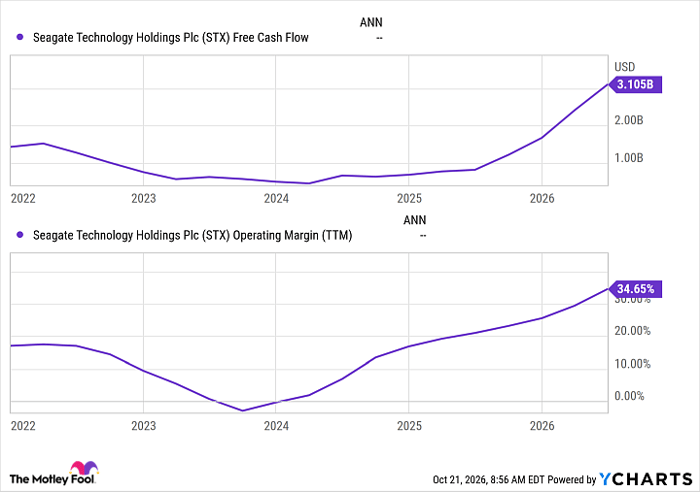
STX Free Cash Flow data by YCharts.
Operating margins have also soared. After dipping into negative territory in late 2023, operating margin now stands at more than 34.6% — an all-time high.
This level of free cash flow gives Seagate options. It can use its ample free cash flow to pay down debt (as it has), make strategic acquisitions, and improve shareholder returns by issuing dividends or repurchasing its stock.
Is Seagate worth owning for the long run?
This brings us to the central question: Is Seagate stock worth owning in the long run?
Bulls will point to Seagate’s crucial role within the AI ecosystem. Simply put, if the AI revolution continues to roll ahead, Seagate is very well positioned to capitalize on it for years to come.
Bears, on the other hand, may argue that owning the stock carries risks. They’re not wrong. For one thing, expectations are already high. Seagate stock is up over 200% over the last 12 months, despite a recent pullback. Customers could also delay orders, the company’s supply chain could become difficult to maintain, and high bulk storage prices may not continue.
Seagate remains a critical part of the AI “library,” thanks to its innovative technology. While AI stocks may remain volatile, long-term investors may be rewarded by owning a company set to provide a crucial piece of AI-related infrastructure for years to come.
Should you buy stock in Seagate Technology Plc right now?
Before you buy stock in Seagate Technology Plc, consider this:
The Motley Fool Stock Advisor analyst team just identified what they believe are the 10 best stocks for investors to buy now… and Seagate Technology Plc wasn’t one of them. The 10 stocks that made the cut could produce monster returns in the coming years.
Consider when Netflix made this list on December 17, 2004… if you invested $1,000 at the time of our recommendation, you’d have $361,596!* Or when Nvidia made this list on April 15, 2005… if you invested $1,000 at the time of our recommendation, you’d have $1,303,935!*
Now, it’s worth noting Stock Advisor’s total average return is 910% — a market-crushing outperformance compared to 211% for the S&P 500. Don’t miss the latest top 10 list, available with Stock Advisor, and join an investing community built by individual investors for individual investors.
See the 10 stocks »
*Stock Advisor returns as of October 24, 2026.
Jake Lerch has no position in any of the stocks mentioned. The Motley Fool has positions in and recommends Micron Technology. The Motley Fool has a disclosure policy.