Key Points
-
Tesla reported another quarter of flat revenue growth.
-
The company hasn’t grown vehicle sales meaningfully in three years.
-
Nearly three-quarters of its revenue comes from its automotive segment.
-
Defining Tesla (NASDAQ: TSLA) has always been a challenging question for investors.
As an electric-vehicle maker, Tesla has never traded like a typical car company. Legacy automakers like General Motors and Ford tend to trade for single-digit price-to-earnings ratios, even though these companies bring in boatloads of profits most years.
Missed AI’s “Act 1”? Act 2 Could Be 15x Bigger. Most investors think they missed the AI boat because they didn’t buy Nvidia in 2005. But according to our analysts, we’re only at the end of “Act 1″—the R&D phase. “Act 2” is the global rollout. Continue »
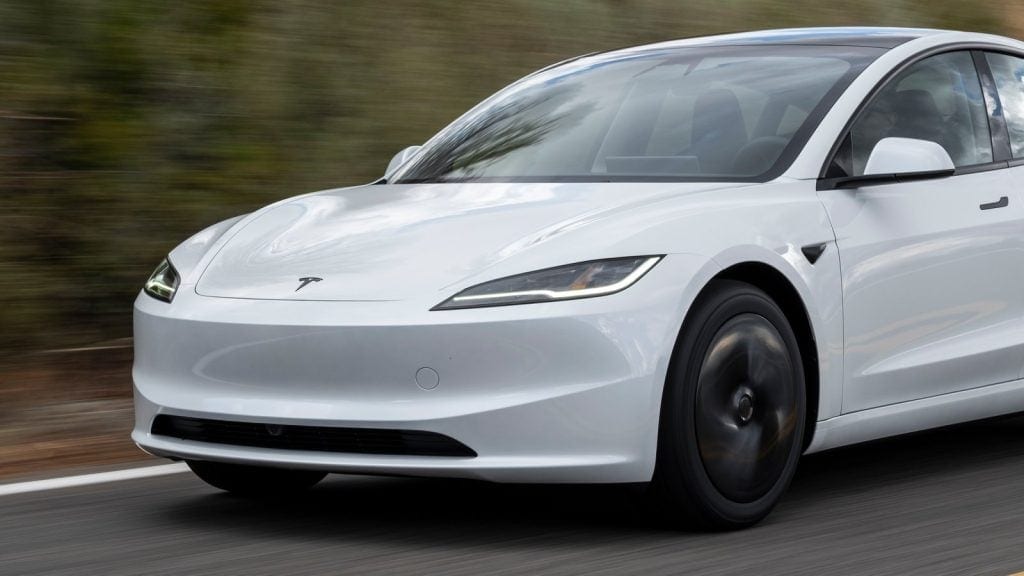
Five years ago, investors seemed assured that electric vehicles would disrupt the whole auto market and that combustion vehicles would be left in the past. However, that hasn’t happened, and Tesla’s vehicle sales have been basically flat over the last three years. Meanwhile, GM and Ford have pulled back from their own efforts in EVs.
After three years of flat vehicle sales, you might expect Tesla stock to swoon, but instead it has kept pace with the S&P 500, climbing to a market cap of $1.5 trillion.
Tesla has managed to do that largely by shifting investor focus away from EVs and to the future.
Elon Musk’s sleight of hand
Tesla CEO Elon Musk is known for making big promises. He has a reputation for being late, but eventually delivering on those.
After taking Tesla’s EV business mainstream against long odds, Musk now sees the future of the company in autonomy, specifically with autonomous vehicles built on the company’s full self-driving technology, and its Optimus autonomous robot, which is in development.
On the third-quarter earnings call, Musk said that he believed Optimus would become “the biggest product ever.” Tesla is currently working to scale production to 20,000 units a week, and it predicted that initial customer deliveries would begin around the end of 2027. Most CEOs wouldn’t move the needle with such a prediction, and would likely be reluctant to make one, but Musk has built up enough credibility with investors that they’re willing to bet on those forecasts.
Similarly, the Tesla chief said that full self-driving (FSD), Tesla’s autonomous vehicle system which still requires human supervision, is the biggest driver of Tesla demand, and even predicted that Tesla would perform the majority of passenger miles in countries where it’s allowed to operate with FSD.
With bombastic statements like that from Musk, perhaps it’s not surprising that the currently no-growth company trades at a price-to-earnings ratio of 200.
Is Tesla a car company?
Tesla’s revenue in the second quarter fell by 0.2% to $28 billion, with automotive revenue down 3% to $20.6 billion, while energy generation and storage revenue slipped 16% to $2.88 billion. Services were the only one of its three segments to grow, with revenue up 33% to $4.6 billion.
Profits fell as the company continues to invest in AI and next-gen products like Optimus.
With nearly three-quarters of its revenue still coming from its vehicles, Tesla is a car company by any reasonable definition. However, the company has been able to separate its valuation from its current status as a no-growth car company.
Tesla’s investments in Optimus, FSD, and AI are clearly worth something, but it remains to be seen whether they can reach significant scale, since huge profits from those businesses are already baked into the price.
Considering that, and Tesla’s own struggles to continue growing its auto business, the stock looks best avoided at this point. At Tesla’s current market cap, investors expect it to grow its annual profit to at least $50 billion, based on valuations of its big tech peers. That will either have to come from new products like Optimus or from the renewed growth of its auto business.
Even if Optimus is a success, it will take several years for the company to reach $50 billion in annual profit, given that its current annual revenue is just $120 billion. Until Tesla proves it’s more than a car company, the math just doesn’t add up.
We just issued ‘double down’ alerts on 3 stocks — find out if Tesla made our list
Ever feel like you missed the boat in buying the most successful stocks? Then you’ll want to hear this.
On rare occasions, our expert team of analysts issues a “Double Down” stock recommendation for companies that they think are about to pop. If you’re worried you’ve already missed your chance to invest, now is the best time to buy before it’s too late. And the numbers speak for themselves:
- Nvidia: if you invested $1,000 when we doubled down in 2009, you’d have $577,076!*
- Apple: if you invested $1,000 when we doubled down in 2008, you’d have $65,619!*
- Netflix: if you invested $1,000 when we doubled down in 2004, you’d have $350,756!*
Right now, we’re issuing “Double Down” alerts for three incredible companies, available when you join Stock Advisor, and there may not be another chance like this anytime soon.
See the 3 stocks »
*Stock Advisor returns as of October 23, 2026.
Jeremy Bowman has no position in any of the stocks mentioned. The Motley Fool has positions in and recommends Tesla. The Motley Fool recommends General Motors. The Motley Fool has a disclosure policy.