Key Points
-
A report that SpaceX wants access to 80,000 U.S. cell sites sent tower stocks soaring and telecom stocks down on Friday.
-
The last company that tried to become America’s fourth wireless carrier ended up fighting its tower landlords in court.
-
There were some big moves in telecommunications stocks on Friday. On one hand, shares of cell tower owners Crown Castle (NYSE:CCI) and American Tower (NYSE:AMT) soared, with shares up by about 9% and 4%, respectively, as of midday. On the other hand, the three largest wireless carriers plunged, with Verizon (NYSE:VZ), AT&T (NYSE:T), and T-Mobile (NASDAQ:TMUS) all deep in the red.
Both moves are due to one company, SpaceX (NASDAQ:SPCX). On Thursday evening, Bloomberg reported that SpaceX is in talks to secure at least 80,000 cell sites across the United States as it aims to become the fourth nationwide wireless carrier. For context, 80,000 sites would represent about half of all the purpose-built cell towers in the U.S., so it would be a pretty big move.
Missed Nvidia in 2009? This Rare Signal Is Flashing Again. In 2009, a “Double Down” signal flashed for a little-known chipmaker called Nvidia. For the first time in years, that same “Total Conviction” signal is flashing for a company 1/100th the size of Nvidia. Continue »
Image source: Getty Images.
This is the second time in October that SpaceX has sent shockwaves through the telecom industry. First, on Oct. 9, SpaceX agreed to buy $8 billion in low-frequency wireless spectrum, and telecom stocks plunged. So, will SpaceX truly boost the tower companies and cost the telecom leaders money?
Why are the tower companies soaring?
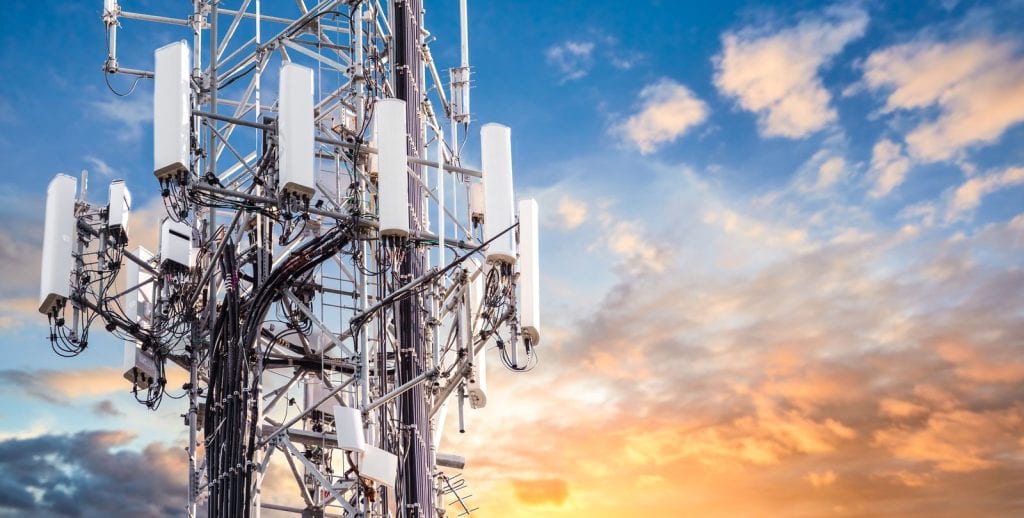
First, a little context on how the cell tower business works. The owner builds a tower and then rents space on it to wireless carriers, typically under long-term leases. Next time you drive by a cell tower, take a look at the top. You’ll probably see several rings of transmission equipment, and each of those represents a tenant. Since the tower is already standing, adding tenants produces extra revenue with very little additional cost.
Ever since Sprint was acquired by T-Mobile, the tower industry has essentially had three wireless customers. The majority of Crown Castle’s rent comes from AT&T, Verizon, and T-Mobile. A well-capitalized fourth player would mean more tenants per tower.
This is also a notable expansion of SpaceX’s plans. Although the company has made its telecom network ambitions known for some time, as recently as August, management described its network as small cells mounted on rooftops (not traditional towers). But without getting too technical, the low-band spectrum it bought makes large towers far more useful, so it makes sense to add them to the plan.
Of course, this isn’t the first time a “fourth carrier” has emerged. Just a few years ago, Dish Network signed long-term tower leases to build its own 5G network. To make a long story short, Dish’s parent company sold most of its spectrum in 2025 and began shutting down the network. Of course, SpaceX is a far more deep-pocketed tenant and could easily afford to build a nationwide network.
Should investors forget about the carriers?
SpaceX is certainly a threat to the big three wireless carriers, but the recent sell-off appears a bit overdone. After all, SpaceX would be starting with no wireless customers at all, it holds less spectrum than any of the others, and its service isn’t expected to launch commercially until late 2027. And building a competitive network would be a multiyear process at a minimum.
Let’s be clear. SpaceX could certainly pressure the three major wireless carriers over time, but this isn’t exactly a death sentence for them either. All have existed in the past with a fourth competitor (Sprint), and pricing power hasn’t changed that much since the number dropped to three.
The bottom line
If you’re thinking about buying tower owners as a momentum play or telecoms at a discount, it might be a smart idea to be patient. For one thing, although Crown Castle was specifically mentioned as a company SpaceX was in talks with, there isn’t a signed contract or any official management acknowledgment yet. And the telecom sell-off may be overdone, as all that is happening right now is that a potential competitor (who would be starting from scratch) is negotiating with landlords.
In a nutshell, the market is pricing in a deal that hasn’t happened yet, and the reaction on both the tower owner and wireless carrier side may be a bit overdone. I’m keeping an eye on some of the stocks involved, but I’m waiting for further official developments before making any moves.
Should you buy stock in Space Exploration Technologies right now?
Before you buy stock in Space Exploration Technologies, consider this:
The Motley Fool Stock Advisor analyst team just identified what they believe are the 10 best stocks for investors to buy now… and Space Exploration Technologies wasn’t one of them. The 10 stocks that made the cut could produce monster returns in the coming years.
Consider when Netflix made this list on December 17, 2004… if you invested $1,000 at the time of our recommendation, you’d have $361,596!* Or when Nvidia made this list on April 15, 2005… if you invested $1,000 at the time of our recommendation, you’d have $1,303,935!*
Now, it’s worth noting Stock Advisor’s total average return is 910% — a market-crushing outperformance compared to 211% for the S&P 500. Don’t miss the latest top 10 list, available with Stock Advisor, and join an investing community built by individual investors for individual investors.
See the 10 stocks »
*Stock Advisor returns as of October 23, 2026.
Matt Frankel, CFP® has no position in any of the stocks mentioned. The Motley Fool has positions in and recommends American Tower and Crown Castle. The Motley Fool recommends T-Mobile US and Verizon Communications. The Motley Fool has a disclosure policy.