Key Points
-
Lam Research’s stock dropped after its latest quarterly report, but this is a great buying opportunity for savvy investors.
-
Lam is poised to benefit from a massive addressable market, which should allow it to sustain healthy earnings growth over the next four years.
-
Lam stock could easily double by 2030, even if it grows at a conservative pace.
-
The artificial intelligence (AI) infrastructure boom has supercharged the memory market, leading to a phenomenal surge in the share prices of Micron Technology and Sandisk.
Memory demand has significantly outpaced supply, leading to a sharp increase in prices of both dynamic random-access memory (DRAM) and NAND flash. Notably, the memory shortage may not end until 2030 despite attempts by manufacturers to bring more supply online. So, the favorable market conditions driving Micron and Sandisk’s growth are here to stay.
Missed Nvidia in 2009? This Rare Signal Is Flashing Again. In 2009, a “Double Down” signal flashed for a little-known chipmaker called Nvidia. For the first time in years, that same “Total Conviction” signal is flashing for a company 1/100th the size of Nvidia. Continue »
However, there is another memory industry participant that’s benefiting from the market’s boom. Shares of Lam Research (NASDAQ:LRCX), which sells chipmaking equipment, have jumped 64% over the past year. The company released its fiscal 2027 first-quarter results (for the three months ending Sept. 27) on Oct. 21, and its performance clearly indicates that the incredible demand for memory from AI data centers could send the stock even higher.
Let’s see why this semiconductor stock has room for more upside.
Image source: Getty Images.
Lam Research is winning big from the AI infrastructure build-out
Lam Research reported fiscal Q1 revenue of $8.22 billion, up nearly 55% from the year-ago period. What’s more, the company’s non-GAAP operating margin increased by 5.2 percentage points year over year to 40.2% last quarter. This explains why Lam’s adjusted earnings per share jumped by almost 75% from the year-ago period to $2.20.
Wall Street was looking for $2.18 in earnings per share on revenue of $8.14 billion. Additionally, Lam’s guidance for the current quarter suggests that its red-hot growth is here to stay. The company anticipates $8.6 billion in revenue and $2.33 in adjusted earnings per share in the current quarter at the midpoint of its guidance range.
The guidance implies a 52% year-over-year increase in revenue, and a stronger year-over-year jump of 84% in earnings per share. However, Lam stock fell more than 8% following its quarterly report, as the company’s guidance was in line with Wall Street’s expectations. Investors were probably expecting Lam’s guidance to crush consensus estimates, and that wasn’t the case.
I think that the slide is an opportunity for savvy investors to buy a top growth stock, considering that Lam is sitting on a massive growth opportunity that could fuel its growth until the end of the decade. After all, the company sells wafer and fabrication equipment (WFE), and the memory industry accounts for 46% of its revenue.
Industry association SEMI noted in July that global semiconductor manufacturing equipment sales will increase 23% in 2026 to $166 billion. Even better, the market’s revenue could hit $201 billion in 2027 and $229.5 billion in 2028. Memory will play a central role in this market’s expansion.
SEMI points out that DRAM equipment sales could increase by 39% in 2026, 27% next year, and 15% in 2028. Meanwhile, NAND flash equipment sales are on track to increase by 31% in 2026 and 2027, followed by a 14.5% increase in 2028. So, Lam’s addressable market is on track to grow sizably by 2028.
However, I won’t be surprised to see strong WFE spending beyond 2028. Bank of America estimates that WFE spending could hit $360 billion in 2030, more than double this year’s projected spending. Not surprisingly, analysts have been increasing their revenue expectations for the next couple of fiscal years.
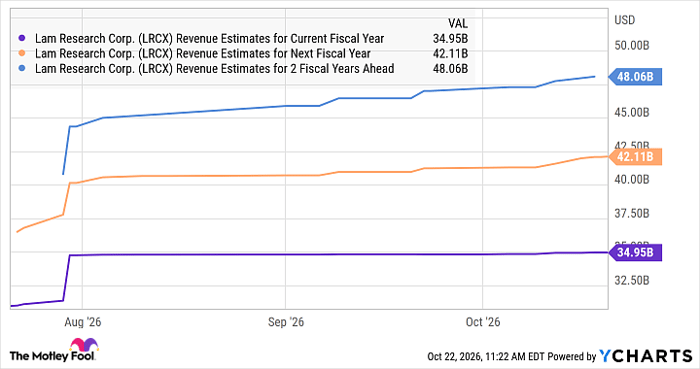
LRCX Revenue Estimates for Current Fiscal Year data by YCharts
Here’s why it is a good idea to invest $10,000 in this stock right now
If you have $10,000 in investable cash right now, and you’re looking to diversify your portfolio, then buying this AI stock with that money could be a smart move. That’s because Lam will not only help investors capitalize on the memory market’s growth but also enable them to benefit from the broader semiconductor equipment industry’s growth.
Lam’s earnings per share could increase by 64% in the current fiscal year to $9.57, according to consensus estimates. The forecast for the next couple of years points to robust double-digit growth.
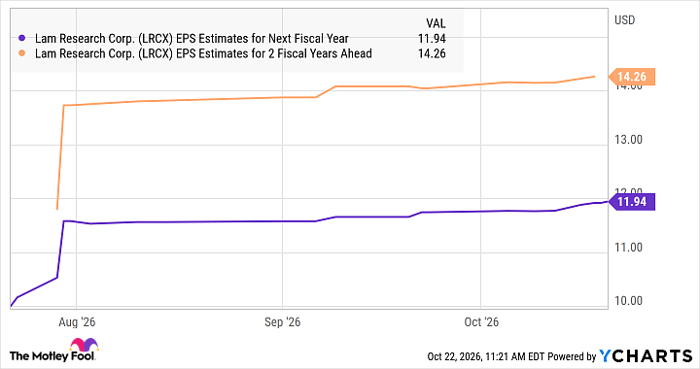
LRCX EPS Estimates for Next Fiscal Year data by YCharts
However, as the chart below shows, analysts are becoming bullish on the company’s long-term earnings growth potential.
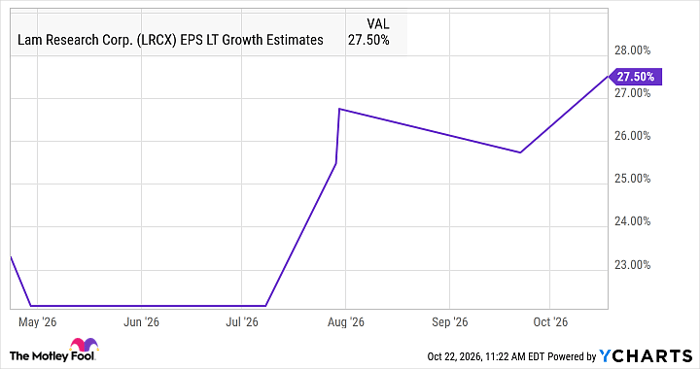
LRCX EPS LT Growth Estimates data by YCharts
Assuming Lam’s bottom line jumps by even 20% in fiscal 2030, its earnings per share could reach $17.11 after four years (using fiscal 2029’s projected EPS of $14.26 as the base). If Lam trades at 30 times earnings at that time, in line with the tech-focused Nasdaq-100 index’s earnings multiple, its stock price will reach $513. That implies a potential upside of 116%, meaning a $10,000 investment in this stock could be worth more than $21,600 after four years.
So, buying Lam Research stock following its post-earnings slide could be a profitable move, as the secular growth of the memory and semiconductor equipment markets will be a long-term tailwind for the company.
Should you buy stock in Lam Research right now?
Before you buy stock in Lam Research, consider this:
The Motley Fool Stock Advisor analyst team just identified what they believe are the 10 best stocks for investors to buy now… and Lam Research wasn’t one of them. The 10 stocks that made the cut could produce monster returns in the coming years.
Consider when Netflix made this list on December 17, 2004… if you invested $1,000 at the time of our recommendation, you’d have $361,596!* Or when Nvidia made this list on April 15, 2005… if you invested $1,000 at the time of our recommendation, you’d have $1,303,935!*
Now, it’s worth noting Stock Advisor’s total average return is 910% — a market-crushing outperformance compared to 211% for the S&P 500. Don’t miss the latest top 10 list, available with Stock Advisor, and join an investing community built by individual investors for individual investors.
See the 10 stocks »
*Stock Advisor returns as of October 23, 2026.
Bank of America is an advertising partner of Motley Fool Money. Harsh Chauhan has no position in any of the stocks mentioned. The Motley Fool has positions in and recommends Lam Research and Micron Technology. The Motley Fool has a disclosure policy.