Key Points
-
Meta is one of today’s leading AI players and a social media giant.
-
The company has invested billions of dollars in the AI infrastructure build-out, and some investors have worried about the impact of such spending.
-
Meta Platforms (NASDAQ:META) is one of the main companies driving the artificial intelligence (AI) boom. Though you may know Meta best for its social media apps — from Instagram to WhatsApp — the company has expanded its focus in recent years to include AI research and development.
These businesses actually fit well together — with AI improving and enhancing the apps, users may spend more time on them. As a result, advertisers might buy more ad placement across these platforms. Meanwhile, Meta’s AI tools are leading to new revenue streams. But all of this comes with a price. Meta has invested billions of dollars into R&D to achieve its AI goals, and investors haven’t always been happy about these levels of spending.
Missed Nvidia in 2009? This Rare Signal Is Flashing Again. In 2009, a “Double Down” signal flashed for a little-known chipmaker called Nvidia. For the first time in years, that same “Total Conviction” signal is flashing for a company 1/100th the size of Nvidia. Continue »
Right now, though, Meta is doing something it’s never done before, and this move could help fund its AI projects. Let’s find out what all of this means for investors.
Image source: Getty Images.
The Meta story so far
First, a quick note on Meta’s business and earnings picture so far. The company generates most of its revenue through advertising across its social media apps, and over time, this has helped earnings to climb. In the recent quarter, revenue advanced in the double digits to $64 billion, and net income came in at $9.8 billion. (This was a triple-digit gain, but it isn’t particularly relevant as it was due to a change in a tax rate.)
Importantly, the company said its AI investments are already boosting ad revenue through stronger engagement and improved recommendations.
As mentioned, Meta has made spending on AI a top priority over the past few years. The company has built out its own data centers, developed AI models, and even created a superintelligence lab led by industry experts. All of this has pushed capital expenditures higher quarter after quarter. And this has weighed on free cash flow.
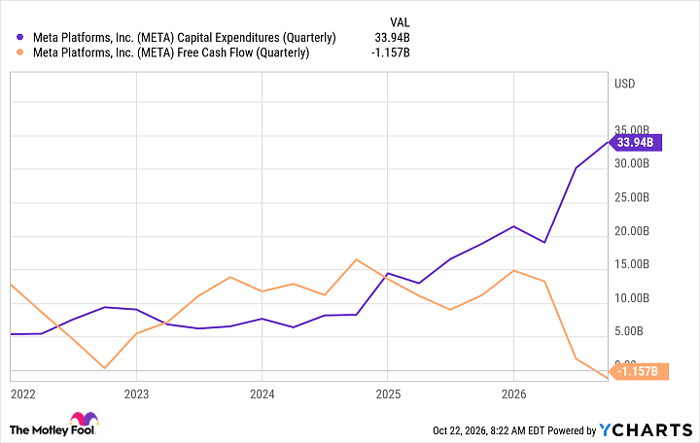
META Capital Expenditures (Quarterly) data by YCharts
In the latest quarter, Meta said that capex primarily went toward servers, data centers, and network infrastructure. The company narrowed its 2026 capex range to $135 billion to $145 billion from the prior outlook of $130 billion to $145 billion and said that into the future it will “continue investing aggressively.”
Now, let’s consider the fresh move Meta’s about to make. For the first time, the company has announced a stock split. The operation is a bit different from a standard split, in which a company issues more of the same class of shares to current shareholders.
Preserving Mark Zuckerberg’s power
Instead, Meta is creating a new class of shares, Class C shares that don’t have voting rights. The company will offer one of these shares to current shareholders for each share they already own. As a result, this will double the share count, but it won’t interfere with chief executive officer Mark Zuckerberg‘s voting power.
The move is particularly positive for the company and shareholders because it offers more financing flexibility, and at a time when investors are concerned about Meta’s investment in the AI build-out. For example, Meta could sell new Class C shares to the public to raise cash, without diluting Zuckerberg’s holding. The company also could decide to use Class C shares instead of cash to pay for a potential acquisition or offer employees such shares. So, this decision offers Meta attractive new ways to raise cash and bring in and keep talent. That’s positive for the company as it reduces financial risk and maintains Zuckerberg’s leadership.
As with a traditional stock split, this operation doesn’t change anything fundamental such as market value. It will unfold on Jan. 19, and it will be paid to current shareholders in the form of a dividend. As essentially a 2-for-1 stock split, the value of the stock, based on the Oct. 21 closing price of $697, would be $348 after the operation. Of course, this value could change greatly depending on the stock’s performance up until that time.
Though the stock split itself may be a non-event for investors, Meta’s post-split financial flexibility is good news, reinforcing the buy case for this top tech player.
Should you buy stock in Meta Platforms right now?
Before you buy stock in Meta Platforms, consider this:
The Motley Fool Stock Advisor analyst team just identified what they believe are the 10 best stocks for investors to buy now… and Meta Platforms wasn’t one of them. The 10 stocks that made the cut could produce monster returns in the coming years.
Consider when Netflix made this list on December 17, 2004… if you invested $1,000 at the time of our recommendation, you’d have $350,756!* Or when Nvidia made this list on April 15, 2005… if you invested $1,000 at the time of our recommendation, you’d have $1,363,905!*
Now, it’s worth noting Stock Advisor’s total average return is 922% — a market-crushing outperformance compared to 213% for the S&P 500. Don’t miss the latest top 10 list, available with Stock Advisor, and join an investing community built by individual investors for individual investors.
See the 10 stocks »
*Stock Advisor returns as of October 23, 2026.
Adria Cimino has no position in any of the stocks mentioned. The Motley Fool has positions in and recommends Meta Platforms. The Motley Fool has a disclosure policy.