

Key Points
-
The all-important question of how much Social Security benefits will rise in 2027 will be answered on Oct. 14.
-
Two of President Donald Trump’s policies are directly affecting consumer prices and raising estimates for Social Security’s 2027 cost-of-living adjustment (COLA).
-
However, beefier Social Security raises have a significant downside for a program that’s already on shaky financial footing.
The answer to the most important question for more than 71 million traditional Social Security beneficiaries is just over one month away. On Oct. 14, the U.S. Bureau of Labor Statistics will publish the September inflation data, providing the final puzzle piece needed to calculate Social Security’s 2027 cost-of-living adjustment (COLA), and answer the all-important question: “How much will I receive monthly next year?”
Social Security’s COLA is the near-annual raise given to beneficiaries that accounts for inflation (rising prices). If a large basket of goods and services regularly purchased by Social Security recipients increases in cost by 2.5% from the previous year, benefits would need to climb by the same percentage to ensure no loss of Social Security income buying power.
Missed Nvidia in 2009? This Rare Signal Is Flashing Again. In 2009, a “Double Down” signal flashed for a little-known chipmaker called Nvidia. For the first time in years, that same “Total Conviction” signal is flashing for a company 1/100th the size of Nvidia. Continue »
Next year’s COLA is shaping up as a mixed bag for tens of millions of retired-worker beneficiaries. On the one hand, President Donald Trump’s policies are set to boost benefits via a “Trump bump” and potentially deliver a rare silver lining that hasn’t been witnessed since 2023. Conversely, this estimated outsize hike could have dire consequences in the coming years.
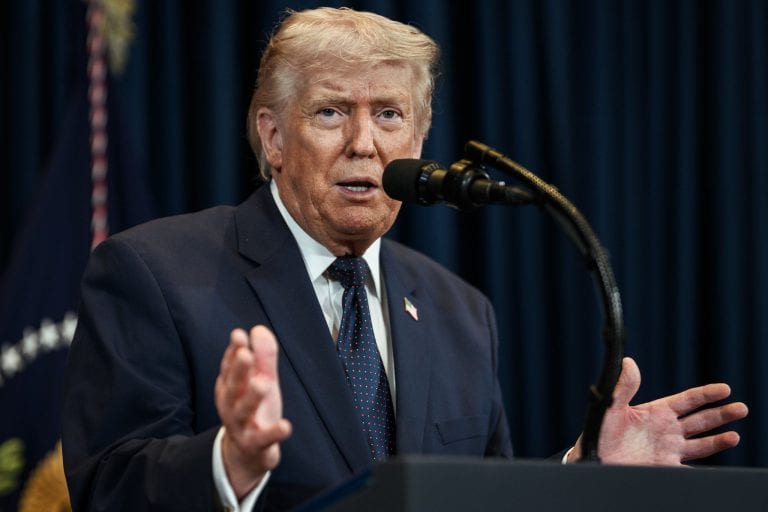
President Trump’s policies are a mixed bag for America’s leading retirement program. Image source: Official White House Photo by Molly Riley.
The first Social Security silver lining since 2023 may be on the way for select retirees
A modest level of inflation is perfectly normal for a growing economy. Since Social Security’s cost-of-living adjustment is designed to offset inflation, modest COLAs tend to be the norm.
But this is unlikely to be the case in 2027, thanks to two of President Trump’s policies: tariffs and the Iran war.
In April 2025, Trump unveiled sweeping global tariffs and higher reciprocal tariffs on dozens of countries with adverse trade imbalances with America. Despite the U.S. Supreme Court striking down many of these tariffs in February 2026, the lift that tariffs provided to consumer prices ultimately boosted Social Security’s 2026 COLA.
This same story is set to play out with the 2027 COLA. In July, the Trump administration reimposed sweeping global tariffs ranging from 10% to 12.5%. These added duties on imported goods can raise domestic production costs, which are then passed on to consumers.
Meanwhile, the Iran war is meaningfully lifting the prevailing inflation rate. The largest energy supply disruption in modern history, caused by Iran’s closure of the Strait of Hormuz, sent energy prices soaring. The price stickiness of core inflation readings also suggests that Iran-war-driven inflation has spilled over into the broader economy.
The Fed’s preferred inflation gauge, Core PCE, came in at 3.3% for July.
That marks 65 consecutive months above the Fed’s 2% target.
In June, Kevin Warsh said:
“We’ve missed for 5 years. And we’re gonna fix that.”
So far: all talk, no action.
Video: https://t.co/9oZTwtA7vK pic.twitter.com/D5q3QLAEI1
— Charlie Bilello (@charliebilello) August 26, 2026
Following the release of the July inflation report, independent estimates from The Senior Citizens League and policy analyst Mary Johnson called for raises of 3.6% and 3.4%, respectively.
The real benefit of a well-above-average COLA should be seen by the tens of millions of retirees also enrolled in traditional Medicare.
Traditional Medicare has three core components: Part A (in-hospital stays), Part B (outpatient services), and Part D (prescription drugs). Part B has a standard monthly premium of $202.90 in 2026, with higher-income individuals potentially paying more.
Throughout most of the 21st century, the year-over-year percentage increase in Medicare’s Part B premium has been notably larger than Social Security’s annual COLA. For instance, Social Security raises of 3.2% (2024), 2.5% (2025), and 2.8% (2026) were met with Part B premium increases of 5.9% (2024), 5.9% (2025), and 9.7% (2026). This dynamic often results in Social Security’s COLA being gobbled up (in part or in full) by Part B premium hikes.
But according to the 2026 Medicare Trustees Report, the Part B premium is only expected to rise by 3.25% to $209.50/month in 2027. If accurate, it would mark the first time since 2023 that Social Security’s COLA is rising at a higher percentage than Medicare’s Part B premium. Retirees retaining more of next year’s raise would be a rare silver lining.

Image source: Getty Images.
Social Security’s silver lining comes with a dark cloud, as well
While Social Security’s Trump bump-powered COLA may help tens of millions of retirees next year, there’s a relatively steep price to be paid for this outsize benefit increase.
According to the Social Security’s 2026 Board of Trustees Report, the Old-Age and Survivors Insurance trust fund (OASI) is on shaky ground. This is the fund that doles out monthly benefits to retired workers and survivors of deceased workers.
The good news is that the OASI isn’t going bankrupt and won’t halt benefits. If you qualify for a retirement or survivor benefit, you’ll be receiving one. However, the sustainability of the existing payout schedule, including annual COLAs, is very much in question.
The latest Trustees Report projects the OASI’s asset reserves — i.e., the excess income collected since inception that’s invested in special-issue, interest-bearing government bonds, as required by law — will be depleted by the fourth quarter of 2032. If the OASI’s asset reserves are exhausted, sweeping benefit cuts of up to 22% may follow.

US Old-Age and Survivors Insurance Trust Fund Assets at End of Year data by YCharts
When the Trustees model short- (10-year) and long-term (75-year) financial outlooks for Social Security, they assume modest annual cost-of-living adjustments. But when the prevailing inflation rate is notably above average, larger Social Security raises are expected. President Trump’s policies are driving up inflation, which, in turn, is expected to boost Social Security’s COLA and potentially drain the OASI’s asset reserves even faster than forecast.
Again, this doesn’t mean Social Security is bankrupt or will halt benefits. Rather, the implication is that it could speed up the timeline to projected benefit cuts, moving them from the fourth quarter of 2032 to an even earlier date.
If tens of millions of beneficiaries enrolled in traditional Medicare receive their silver lining in 2027, it’ll likely also come with a dark cloud for all beneficiaries.
The $23,760 Social Security bonus most retirees completely overlook
If you’re like most Americans, you’re a few years (or more) behind on your retirement savings. But a handful of little-known “Social Security secrets” could help ensure a boost in your retirement income.
One easy trick could pay you as much as $23,760 more… each year! Once you learn how to maximize your Social Security benefits, we think you could retire confidently with the peace of mind we’re all after. Join Stock Advisor to learn more about these strategies.
View the “Social Security secrets” »
The Motley Fool has a disclosure policy.



12 Comments
Seniors should be free of government dependence. None of them should be begging for the scraps that fall from government’s grand buffet table. Social Security keeps them begging while depriving them of the capital to care for themselves throughout their working lives. The systems “Pay it backwards” architecture has always been inverted, and as a result it has become the world’s largest Ponzi scheme with the social effects of a mutigenerational opiate addiction. Nothing good has or ever will come from the continuation of this fraudulent system.
Join Stock Advisor
they need to lower the Medicare premiums, the Seniors who have spenddowns in Medicare to stop it & pay all seniors’ on Medicaid to get free Medicaid their bills paid never to be in medical bill debt , all who need surgeries, transplants , injections procedures to be able to get them with out worry or denial, American citizens count first come first before illegla aliens, as do veterans
they need to lower the Medicare premiums, the Seniors who have spenddowns in Medicare to stop it & pay all seniors’ on Medicaid to get free Medicaid their bills paid never to be in medical bill debt , all who need surgeries, transplants , injections procedures to be able to get them with out worry or denial, American citizens count first come first before illegla aliens, as do veterans
Tell me why these officials do not know that all foreign presidents are fully responsible for their foreign born people of all ages past, present & future? Why American paid officials have not told foreign presidents it is their responsibility to mandate their foreign born people to pay for their own photo certified legal passport so their foreign born people can travel outside their own country to enter USA& other foreign countries legally & that is anyone has an accident who is foreign born that travels illegally into USA, or any other foreign country, the foreign president & the parents are fully responsible, not the country foreign born people entered illegals. Why haven US elected officials made every foreign president aware that they are fully responsible for the shutting down of their foreign borders , foreign president are responsible for licensing buildings to create legal product, jobs & decent wages in their own foreign country’s to supply them with proper health care they pay for out of their companies they work for in their foreign countires . American citizens should not be handing out American jobs . nor should foreign presidents be allowing their licensing of building to manufacture illegal drugs to cartels distributing these illegal drugs to USA or other foreign country’s . this makes foreign president drug dealers not foreign presidents . why are American citizens voting for American paid officials allowing foreign president ‘s linked to drug cartels ?
Interesting discussion about Social Security, the 2027 COLA, and the potential effects on retirees. The article raises useful points about how changes in benefits and inflation could affect household finances, making this a worthwhile topic for anyone following retirement planning. https://www.kingdom-hospitality.net/property-mgmt-companies-milwaukee-wi