
How soon do you want to retire? For most people, the answer to the question is “as soon as possible.” For too many people, though, “as soon as possible” is further away than they like. There’s just not enough money saved up, and Social Security isn’t going to cut it if you start your retirement benefits at the earliest possible age of 62.
The good news is that nearly anyone can retire a little bit earlier than you might believe possible. The bad news is that one silly mistake is preventing that from happening. That simple, avoidable mistake is waiting too long to get serious about building your retirement nest egg.
Starting earlier does more good than investing more later
If you’re putting off getting started, you’re not alone. It’s easy to get discouraged before you even start, so much so that you never even bother starting. That’s particularly true in your early working years when you’re not earning as much as you will later in life. Then, by the time you start making decent money and have some discretionary funds left over at the end of the month, it feels like it’s too late to matter. Talk about a catch-22!
Both excuses, however, are rooted in errant assumptions. The truth is, it’s rarely too late to get started, and it doesn’t take a ton of money to get a meaningful start on your retirement fund.
To illustrate the point, we’ll use a simple but highly applicable hypothetical scenario — let’s call it Plan A. Plan A assumes that for the first 10 years of a 30-year career, you can only tuck away $2,000 per year, but during the second 10-year stretch of a 30-year career you’re earning better money and can come up with an extra $4,000 per year to invest in an S&P 500 (SNPINDEX: ^GSPC) index fund averaging an annual return on the order of 10%. Then, in the last 10 years of your 30-year career, you’re earning even better money and can put $6,000 to work every year in the same fund. How much do you think you might have at the end of that period? Try a whopping $523,000!
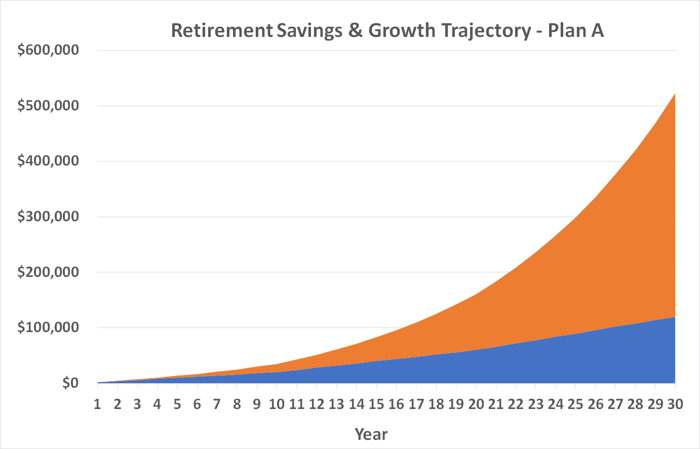
Data source: Calculator.net. Image by author.
The key here is compounding, or earning returns on your previous growth. Your annual contributions are driving more growth than net investment gains are through the first seven years of the 30-year span. Beginning in the eighth year of saving, though, the returns on your gains and contributions start to dramatically exceed your yearly contributions. They never look back, either.