Polymarket has the June rate cut at 2 percent and the full year at 66 percent zero cuts. The actual lifeline for retirement savers in 2026 is hiding three lines into the tax code. Here is the math.
This week, while Polymarket takes nine figures of action on the NBA Championship, the most important number for American retirement got published quietly on Wednesday by the Bureau of Economic Analysis. No flashing ticker. No DraftKings ad. Just a single percentage. And it was the lowest reading in seventeen years.
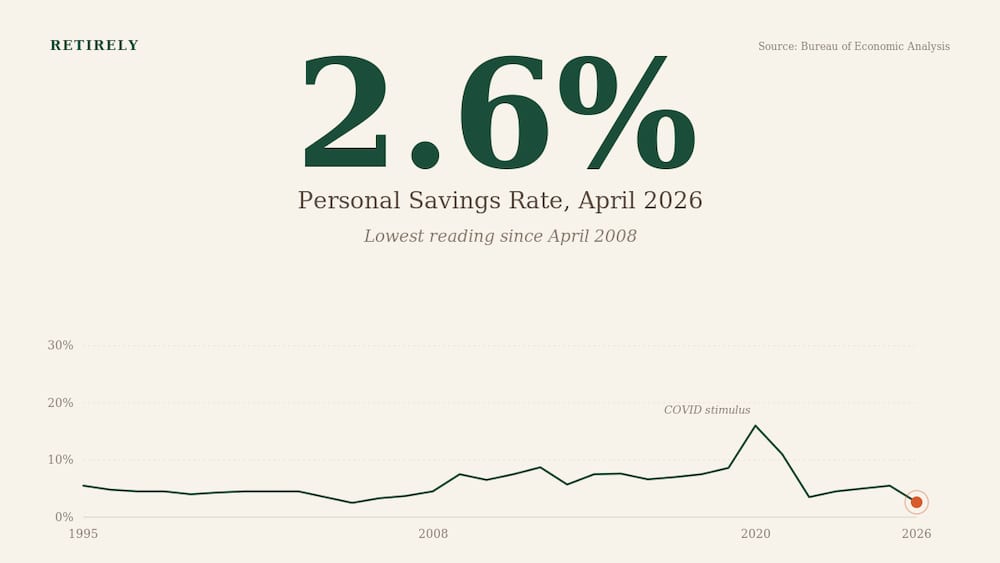
The personal savings rate hit 2.6 percent in April. That is the lowest level since April 2008. The 30 year average is 5.7 percent. Americans are saving less than half of what their parents saved at the same age, for the same reason their parents would have if put in the same spot: the math at the grocery store and the math at the pharmacy stopped agreeing with the math on the paycheck.
The CNN coverage of the release found 37 percent of households will rely on credit or a loan to cover at least some monthly expenses this month, with credit cards and buy now pay later filling the gap. Some of that credit is being layered onto the same paycheck that used to go into a 401(k) match. It shows up in retirement account withdrawals the IRS will be sorting out at tax time in 2027. Suze Orman called this exact dynamic in March: the Medicare premium hike was going to eat the COLA, and people would compensate by raiding savings. The April savings rate is the receipt for that warning.
So when does the Federal Reserve cut rates to give household budgets some breathing room?
Polymarket has an answer, and it is not the one anyone is hoping for. The prediction market is pricing in a 98 percent probability of no change at the June 17 FOMC meeting. For the full year 2026, Polymarket has zero rate cuts at 66 percent, with one 25 basis point cut at 19 percent. Core PCE inflation is running at 3.2 percent, still well above the Fed’s 2 percent target, in part because of the energy price spike tied to the Iran war. The Fed funds rate has held in the 3.50 to 3.75 percent band since January. There is no help coming from interest rates this year, and quite possibly not until well into 2027.
That is a hard sentence, so here is the good news, because there is some.
The most useful piece of retirement legislation Congress has passed in this decade is sitting essentially undiscussed in coverage of the savings panic. The SECURE Act 2.0, signed at the end of 2022, created a super catch-up contribution window for workers ages 60 through 63. Starting in 2025 and continuing in 2026, anyone in that four year age bracket can put more pre tax dollars into a 401(k), 403(b), or governmental 457(b) than at any other age in their working life. And almost nobody is using it.
Here is the actual math. For 2026, the basic 401(k) deferral limit is $24,500. The regular catch up for everyone 50 and older is $8,000, bringing the standard 50 plus total to $32,500. But anyone aged 60, 61, 62, or 63 in 2026 qualifies for the super catch up of $11,250 instead of $8,000. That brings the total for the four year window to $35,750 a year, before any employer match.
For a worker who started saving late, or stopped to raise kids, or ran a small business that did not allow 401(k) deferrals, this is the single biggest opportunity to repair a retirement balance the tax code has ever offered. And the window only lasts four years. Once a saver turns 64, the super catch up is gone and the regular 50 plus catch up applies again.
So what should an actual near retiree do with this on a Friday morning in May?
Three things. First, if you are in the 60 to 63 window and your plan administrator has implemented the super catch up, find out today whether your contribution election is set to the new higher cap. Many plans require an explicit opt in. The dollars do not show up by default
Second, if you are not in that window but you have someone in your family who is, this is the call to make this weekend. A parent who is 62 and not maxing the super catch up is leaving roughly $3,250 a year in tax advantaged contributions on the table, every year, for four years.
Third, notice that the news cycle is not wired to report this. A savings rate at a seventeen year low is a number reporters know how to write. A four year super catch up window opened by a law that passed in 2022 without anyone noticing is, evidently, not. Both stories matter. Only one comes with a Polymarket angle.
Polymarket has markets on what the Fed will do in June and what core PCE prints in July. It does not have a market on whether the household three doors down will figure out the super catch up provision in time to use it. That question already has an answer. It is, for now, mostly no. It does not have to stay that way.
The savings rate is real. The seventeen year low is real. The Fed is not going to make this easier for the rest of the year. But the law that quietly went into effect last January is also real, and it is one of the most useful pieces of retirement tax code ever written, and almost nobody is using it.
That is, in its own quiet way, news. Good news, even. Just no one is taking bets on it.