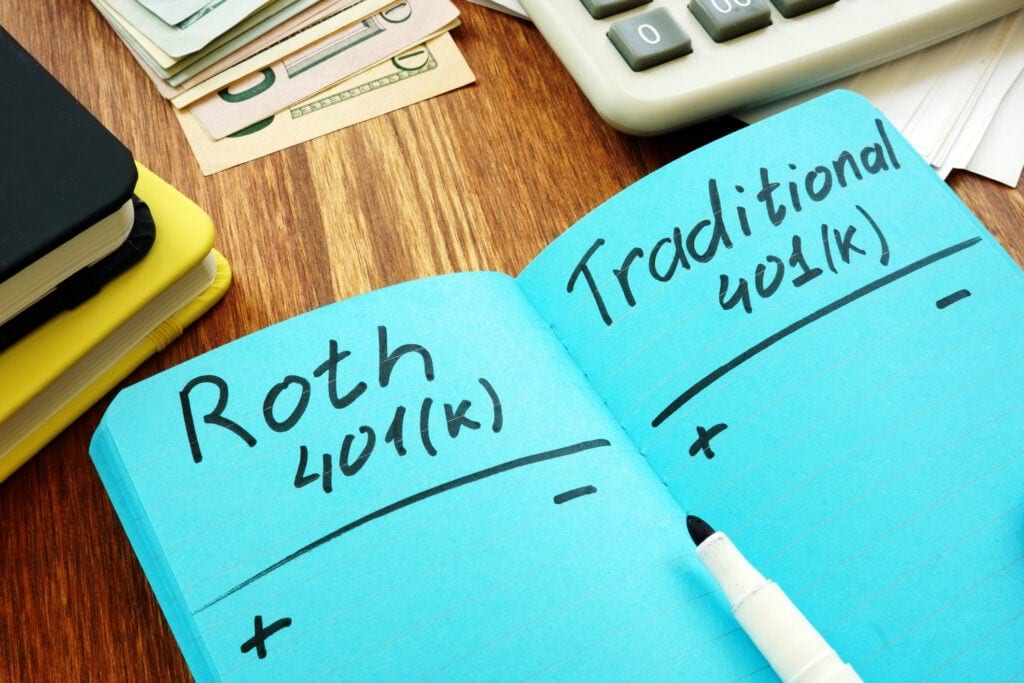
More and more employers are offering a Roth 401(k) as an option for employees to save for retirement, but it’s probably not a great deal for most savers.
A Roth 401(k) allows you to contribute funds to retirement that you pay taxes on today. Those funds can grow tax-free, and distributions in retirement come out tax-free as well. With the SECURE 2.0 act, matching contributions can get the Roth treatment as well.
While the promise of a tax-free retirement might sound great, using a Roth 401(k) could end up costing more than just paying the taxes. And you can probably save more by using the traditional tax-deferred retirement savings account. Here are two reasons to avoid a Roth 401(k) for your retirement savings.
Image source: Getty Images.
1. The costs probably don’t outweigh the savings
A regular taxable brokerage account could produce better savings than a Roth 401(k).
The biggest drawback of saving in a 401(k) are the fees — 401(k) fees include administrative, investment, and service fees, and they can add up quickly. The average 401(k) account pays fees equal to 0.87% of its assets.
While 0.87% might not sound like much, it adds up quickly. Not only do the fees come out every year, but you also lose the opportunity for the money spent on fees to compound over time.
By comparison, you can pick your own brokerage account and pay close to $0 in fees per year. There are index funds with expense ratios of just a few hundredths of a percent.
While you’ll have to pay taxes on your retirement savings when you sell, you’ll likely be able to keep the tax burden very low. The rate for long-term capital gains tax is just 15% for an individual with over $44,625 in taxable income, or $89,250 for a married couple. Less than that, and you’ll pay 0% in taxes. There’s a 20% tax bracket for really high earners, and you might also owe state and local income tax on the amount.
But if you compare the costs of the average 401(k) fees to the tax on a taxable account, you’ll see it doesn’t take long for a taxable account to pay off. After 17 years, you’ll have lost more than 15% in fees on your original contribution based on average fees of 0.87%. And you only pay taxes on your gains. The principal investment comes out tax-free.
If you can manage your capital gains in retirement, you can probably come out ahead by using a taxable account instead of a high-fee Roth 401(k). Not to mention, you won’t lock up your funds until age 59 1/2.
2. A traditional 401(k) probably offers more tax savings
Deducting 401(k) contributions from your taxes today will likely result in more usable savings for you in retirement than if you contributed to a Roth 401(k).
The conundrum stems from the fact that when you make a tax-deductible contribution to a traditional 401(k), you reduce your adjusted gross income on your taxes. That means you’re saving on taxes at your marginal tax rate. So, if you contribute $10,000 to your retirement account and you’re in the 22% tax bracket, you’re saving $2,200 on taxes. The corollary is that you’d only be able to contribute about $8,200 to a Roth account, because you’d need to set aside an extra $1,800 (22%) for your higher tax bill.
But it’s very likely you’ll be able to keep your overall taxes in retirement lower than your marginal tax rate today. That’s because the U.S. uses a progressive income tax system. So before you reach the point at which you pay 22% in taxes on each extra dollar you withdraw, you’ll pay 0%, 10%, and 12% on certain amounts of your withdrawals. Even if you and your spouse completely fill the 22% tax bracket in retirement, your effective federal income tax rate will be less than 15%.
A Roth account usually makes sense in extreme cases. When your income is so low that you pay very little taxes already and you want to lock in your low marginal tax rate, it makes sense. But once your income reaches levels at which your marginal tax rate is higher, it usually makes more sense to choose the tax-deferred account over the Roth account.
Consider the long-term implications of the Roth account
When you save for retirement, it’s important to consider more than just the immediate tax consequences of which type of account you use. You may find that you can save a lot more money for retirement if you use either a taxable account or a traditional 401(k) instead when you factor in the impact of fees and paying taxes up front at your marginal tax rate.
The $21,756 Social Security bonus most retirees completely overlook
If you’re like most Americans, you’re a few years (or more) behind on your retirement savings. But a handful of little-known “Social Security secrets” could help ensure a boost in your retirement income. For example: one easy trick could pay you as much as $21,756 more… each year! Once you learn how to maximize your Social Security benefits, we think you could retire confidently with the peace of mind we’re all after. Simply click here to discover how to learn more about these strategies.
The Motley Fool has a disclosure policy.







1 Comment
this advice will lead you down the garden path to MUCH higher taxes in retirement.
looking into the threshold for taxation on SS, you will find when your SS becomes taxable, it is expensive, and the threshold is NOT indexed to inflation, so you’re getting a tax increase every year, and possibly driven to a higher tax bracket.
it is better to paygo your taxes gradually and avoid the draconian RMD’s at 72 or whatever age the congress decides to change it to this year, next year.
if you are a financial planner type, poor advice is always available, including waiting till 70 to collect SS. they do it because it is an easy 8% that the planner does not have to work for.
if you want to set it and forget it, then accept the paltry returns of a financial planner.
I can trade stocks in my ROTH, tax free, all I want: this is BIG.