Key Points
-
Up to 90% of retirees rely on their Social Security income, in some capacity, to cover their expenses.
-
Although President Trump has pledged to protect Social Security, his flagship tax and spending law, the “Big, Beautiful Bill,” is having the opposite effect.
-
Additionally, the Trump-led Iran war can have unintended consequences for the Old-Age and Survivors Insurance trust fund’s asset reserves.
For most retirees, Social Security income isn’t a luxury — it’s a necessity to make ends meet.
Over the last quarter-century, national pollster Gallup has conducted annual surveys of retirees and found that up to 90% rely on their Social Security income, in some capacity, to cover their expenses. Given how foundational this program is for aging workers, you’d think that strengthening its financial integrity would be of the utmost importance for elected officials, including President Donald Trump. But this hasn’t been the case.
Missed Nvidia in 2009? This Rare Signal Is Flashing Again. In 2009, a “Double Down” signal flashed for a little-known chipmaker called Nvidia. For the first time in years, that same “Total Conviction” signal is flashing for a company 1/100th the size of Nvidia. Continue »
Although Trump has repeatedly vowed, while in office and on the campaign trail, to “protect Social Security,” his actions have had the opposite effect, based on the latest projections.

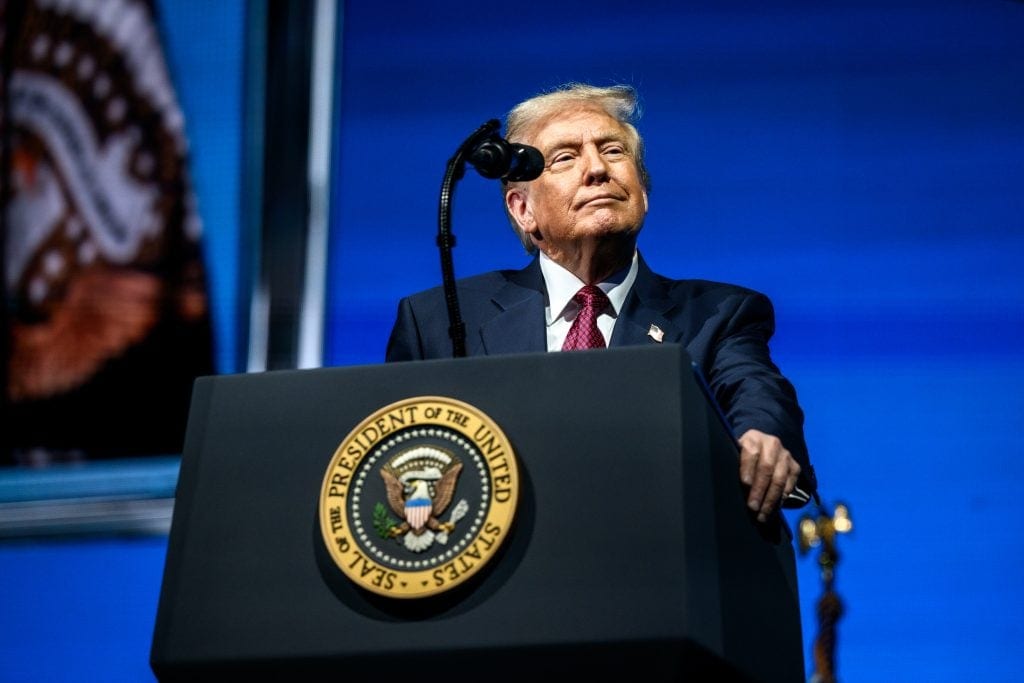
President Trump delivering remarks. Image source: Official White House Photo by Molly Riley.
Trump’s “Big, Beautiful Bill” is a glaring problem for Social Security
Before digging any deeper, let me make one thing clear: Donald Trump isn’t the only reason Social Security’s long-term (75-year) financial outlook is deteriorating. The program’s long-term unfunded obligation has been widening for four decades under both Republican and Democratic presidents and under both unified and divided Congresses.
While the lion’s share of Social Security’s projected $29.3 trillion long-term funding shortfall can be traced to several demographic shifts, such as rising income inequality, historically low U.S. birth rates, and a decline in net legal migration, the latest forecasts suggest President Trump’s vow to protect Social Security is failing miserably.
One way Trump is failing to uphold his Social Security promise is through the passage of his flagship tax and spending law, the “Big, Beautiful Bill,” or BBB.
For some Americans, Trump’s tax policies have been welcome. The BBB’s senior deduction provides a temporary standard deduction increase of $6,000 for select single taxpayers aged 65 and above, or $12,000 for senior couples filing jointly, from tax years 2025 through 2028.
The BBB is also famously known for its “no tax on tips” and “no tax on overtime” provisions, allowing select workers to retain more of their income from 2025 through 2028.
But while the BBB benefits some taxpayers, it’s detrimental to Social Security’s health.
Social Security has three funding sources, none of which is more important than the 12.4% payroll tax on earned income (wages and salaries, but not investment income). Last year, the payroll tax was responsible for over 91% of the income Social Security collected. Trump’s BBB reduces the earnings subject to the payroll tax from 2025 through 2028.
Following a request from Sen. Ron Wyden (D-OR), the Social Security Administration’s Office of the Actuary (OACT) published its projected impact of the BBB on Social Security in early August. The OACT estimates that Trump’s law will increase program costs by $168.6 billion from fiscal years 2025 to 2034 (the federal government’s fiscal year ends on Sept. 30) and accelerate the timeline to sweeping Social Security benefit cuts.

Image source: Getty Images.
Donald Trump’s Iran war can have deleterious effects on America’s leading retirement program
However, the passage of the Big, Beautiful Bill isn’t the only decision that’s hurting Social Security’s financial health. President Trump’s Iran war also deserves its fair share of the blame.
On Feb. 28, Trump gave the U.S. military a green light to attack Iran, prompting the latter to close the Strait of Hormuz to commercial vessels. Approximately 20 million barrels of petroleum liquids pass through the Strait of Hormuz daily, equating to a fifth of global demand. In other words, the Iran war kicked off the largest energy supply disruption in modern history.
If you own a gas- or diesel-powered vehicle, you’ve likely noticed the impact of this disruption at the fuel pump. A surge in energy commodity prices has lifted U.S. trailing 12-month inflation from 2.4% in February to 4.2% in May — a three-year high.
BREAKING: May CPI inflation rises to 4.2%, the highest level since April 2023.
Core CPI inflation also rises to 2.9%, the highest since September 2025.
Inflation in the US is officially back above 4% and more than double the Fed’s target.
Odds of Fed rate hikes are rising.
— The Kobeissi Letter (@KobeissiLetter) June 10, 2026
Inflation is noteworthy for Social Security beneficiaries since it affects their annual cost-of-living adjustment (COLA). Social Security’s COLA is essentially an annual raise given to recipients to counter the effects of inflation and prevent the loss of purchasing power.
With U.S. inflation soaring to a three-year high, Social Security’s 2027 COLA projection has been climbing rapidly, too. The Senior Citizens League, a nonpartisan senior advocacy group, projects benefits will increase by 3.8% next year. Meanwhile, independent Social Security and Medicare policy analyst Mary Johnson foresees benefits rising by 4.7% in 2027.
If Johnson’s lofty forecast proves accurate, beneficiaries would receive the fourth-largest percentage boost to their monthly payout since 1991.
But there’s another side to this potentially history-making Social Security COLA.
BREAKING: The Social Security trust fund is on track to run out of money in late 2032, its trustees said.
It’s three months sooner than projected last year.
— unusual_whales (@unusual_whales) June 9, 2026
According to the 2026 Social Security Board of Trustees Report, the Old-Age and Survivors Insurance trust fund (OASI) — the fund that doles out monthly benefits to retired workers and survivor beneficiaries — is expected to exhaust its asset reserves by the fourth quarter of 2032. Though the OASI is in no danger of bankruptcy or halting payouts, the depletion of its asset reserves would lead to an estimated sweeping benefit cut of up to 22% for retired-worker beneficiaries and survivors of deceased workers.
The Trustees’ forecasts are modeled using modest annual COLAs. A 4.7% raise in 2027 isn’t modest. While it would provide beneficiaries with a sizable monthly boost to their payout, it would almost certainly accelerate the OASI’s asset reserve depletion timeline.
Like several presidents before him, Trump’s promises to protect or strengthen Social Security are failing.
The $23,760 Social Security bonus most retirees completely overlook
If you’re like most Americans, you’re a few years (or more) behind on your retirement savings. But a handful of little-known “Social Security secrets” could help ensure a boost in your retirement income.
One easy trick could pay you as much as $23,760 more… each year! Once you learn how to maximize your Social Security benefits, we think you could retire confidently with the peace of mind we’re all after. Join Stock Advisor to learn more about these strategies.
View the “Social Security secrets” »
The Motley Fool has a disclosure policy.