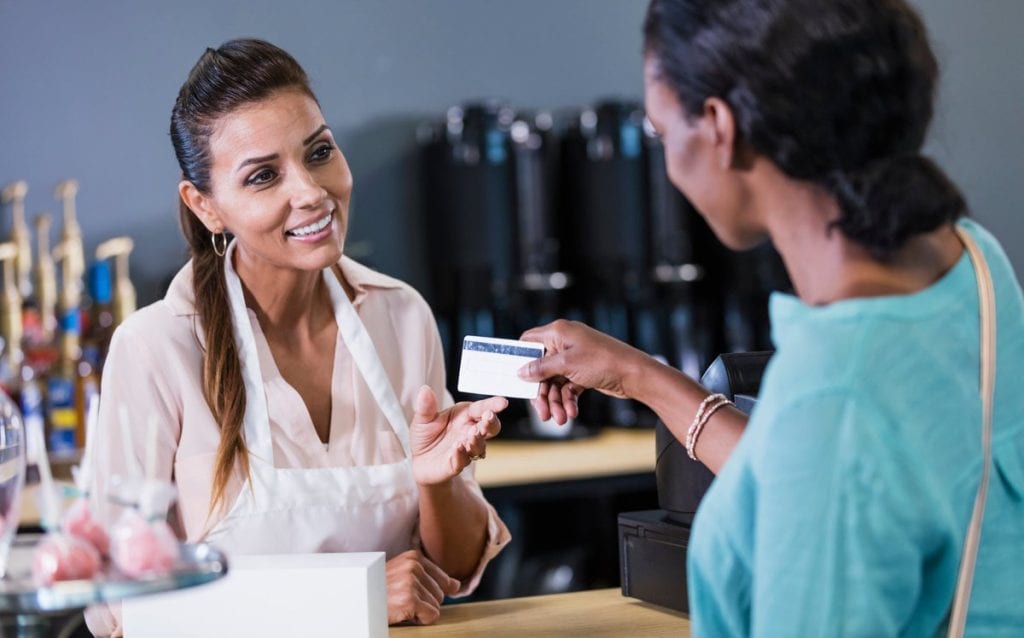

Image source: Getty Images
You tap your card at the coffee shop. The screen flashes “Approved.” You grab your oat milk latte and walk away.
That whole thing took maybe 1.5 seconds. But behind the scenes, an absolutely crazy amount of stuff just happened. Four different companies talked to each other. Fraud models ran. Banks made split-second decisions.
Here’s the full, nerdy breakdown.
Step 1: Your card reader phones home
The moment you swipe, tap, or click “buy now,” the payment terminal reads your card data and sends it to an acquirer — the merchant’s bank. Think of it as the coffee shop’s financial representative.
The acquirer’s job is to figure out where to send your transaction next. That depends entirely on your card’s network — Visa, Mastercard, Amex, or Discover. The acquirer ships your data to whichever logo is on your card.
Not all acquirers work with every network, by the way — which is exactly why some merchants don’t accept Amex or Discover for example.
Step 2: The network becomes air traffic control
Here’s something most people don’t know: Visa and Mastercard don’t actually lend you money. They’re just sophisticated messaging systems — massive global networks that route transactions between banks.
When your card data hits Visa’s network, Visa identifies which bank issued your card and forwards the transaction their way for a decision.
Step 3: Your bank runs a background check on you
This is where it gets genuinely impressive. Your issuing bank receives the transaction and has to make a yes-or-no call in under a second. It’s checking your available credit, flagging any account restrictions, and running a real-time fraud model built around your spending behavior. It checks your usual merchants, typical amounts, location, and time of day.
If this latte fits your pattern, it sails through. If you’re buying something in a city you’ve never visited at 2 a.m., that model raises a flag. Issuers use a combination of rules, machine learning models, and velocity checks to make that call — all invisible to you.
If the transaction gets a green light, your bank fires back an authorization code. If not, you’ll get an instant decline and/or a fraud text asking if the charge was really you.
If you’re curious whether your card is pulling its weight, check out our picks for the best rewards credit cards of 2026.
Step 4: The approval races back the same way it came
The response travels the exact same chain in reverse — issuing bank → network → acquirer → terminal. The whole round trip, from tap to “Approved,” takes just a few seconds.
You’ve just watched four entities pass a message around the globe and back while you were still putting your wallet away.
Plot twist: no money actually moved
One thing worth knowing: that “Approved” message isn’t actually a transfer of money. It’s a reservation, like a promise to pay later.
The real funds movement — called clearing and settlement — happens overnight, which is why transactions sometimes take a day or two to fully post to your account.
The next time your card gets declined for something completely normal, you know exactly what happened. A fraud model somewhere decided your pattern looked off and sent a “no” in under 100 milliseconds.
According to Visa’s FY2024 annual report, its network processed an average of 829 million transactions per day — all running through this same process, all day, every day.
The payments industry sounds boring on the surface. But under the hood, it’s one of the fastest and most quietly complex systems billions of people use without thinking about it.
Ready to put a great card in your wallet? See our picks for the best credit cards of 2026.
Alert: highest cash back card we’ve seen now has 0% intro APR into 2027
This credit card is not just good – it’s so exceptional that our experts use it personally. It features a 0% intro APR for 15 months, a cash back rate of up to 5%, and all somehow for no annual fee!
Click here to read our full review for free and apply in just 2 minutes.
We’re firm believers in the Golden Rule, which is why editorial opinions are ours alone and have not been previously reviewed, approved, or endorsed by included advertisers.
Motley Fool Money does not cover all offers on the market. Editorial content from Motley Fool Money is separate from The Motley Fool editorial content and is created by a different analyst team.American Express is an advertising partner of Motley Fool Money. Joel O’Leary has no position in any of the stocks mentioned. The Motley Fool has positions in and recommends Mastercard and Visa. The Motley Fool recommends Capital One Financial. The Motley Fool has a disclosure policy.