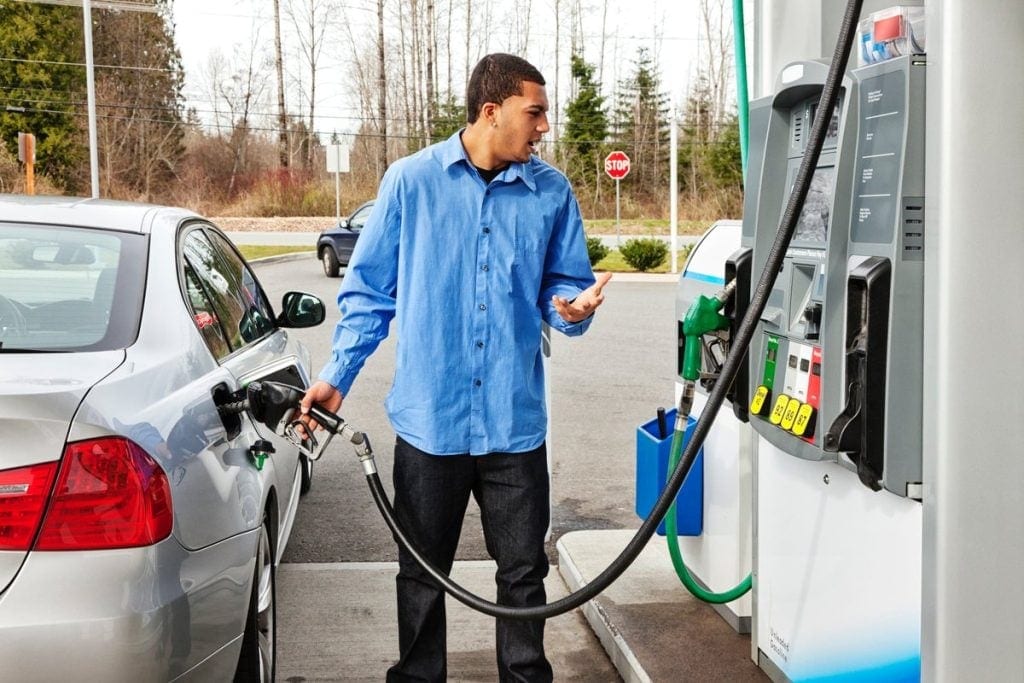

Image source: Getty Images
On average, Americans spend about 3% of their annual budget on gas — roughly $2,411 a year, according to Motley Fool Money research.
That works out to $201 a month just to keep the tank full.
But since the U.S. and Israel launched military operations against Iran in late February, crude oil prices have surged more than 66%. The national average gas price has climbed past $3.88 a gallon as of March 19, 2026 — up nearly $0.80 from a month ago.
For drivers in certain states, the damage is significantly worse.
The 10 states where drivers spend the most on gas
How much you spend monthly at the pump comes down to two things: price per gallon and miles driven.
Here are the top 10 states where Americans spend the most on gas each month on average:
| Rank | State | Est. Monthly Spend | Price/Gal (Mar. 2026) |
|---|---|---|---|
| 1 | Wyoming | $288 | $3.62 |
| 2 | Indiana | $259 | $3.83 |
| 3 | New Mexico | $257 | $3.83 |
| 4 | Mississippi | $257 | $3.49 |
| 5 | Alabama | $253 | $3.58 |
| 6 | California | $243 | $5.62 |
| 7 | Kentucky | $242 | $3.71 |
| 8 | Missouri | $235 | $3.38 |
| 9 | Utah | $222 | $3.84 |
| 10 | Oklahoma | $217 | $3.24 |
Wyoming tops the list not because of price per gallon — but because the average driver logs about 1,800 miles a month, the most of any state in the country.
California has the opposite story. Drivers there average fewer than 1,000 miles a month, well below the national norm, yet spend more because it has the most expensive gas in the country.
As for the states where the average American pays the least, those are Rhode Island, New York, Pennsylvania, Delaware, and New Jersey.
If you’re in a high-spend state, a gas rewards card can put a real dent in that monthly bill. Check out these top gas credit cards in 2026.
Why gas prices are surging right now
When the U.S. and Israel launched strikes on Iran in late February, Iran effectively closed the Strait of Hormuz — the narrow waterway through which roughly one-fifth of the world’s daily oil supply flows.
Crude oil surged more than 66% in a matter of weeks. Gas prices followed, jumping nearly $0.80 a gallon from a month ago. The national average has now hit its highest point of either of Trump’s terms in the White House, and analysts warn prices could climb further if the Strait situation doesn’t improve.
The pain hits hardest for lower-income households, as research shows they spend a higher percentage of their overall budget on gas. An oil shock like this functions as a regressive tax, falling heaviest on those with the least financial flexibility.
Flying isn’t getting cheaper either
The same oil supply shock hitting drivers is working its way into airfare. Jet fuel prices have spiked 82.8% since the start of the conflict, and airlines are already feeling the squeeze.
The average domestic flight was $386 before the war. Expect that number to increase quickly if you’re looking to fly this year. If you travel regularly, a travel rewards card that offsets airfare costs is worth a serious look right now.
The bottom line
No state is fully insulated from an oil shock of this scale. With the Strait of Hormuz still effectively closed, prices aren’t coming down tomorrow.
But a few smart moves can soften the blow. Carpooling, consolidating trips, and using public transport add up over time.
Signing up for fuel rewards programs like Shell Fuel Rewards (save up to $0.10 per gallon) or BP Earnify (save $0.05 per gallon) can give you a little discount, as well as pairing with a solid rewards credit card.
Alert: highest cash back card we’ve seen now has 0% intro APR into 2027
This credit card is not just good – it’s so exceptional that our experts use it personally. It features a 0% intro APR for 15 months, a cash back rate of up to 5%, and all somehow for no annual fee!
Click here to read our full review for free and apply in just 2 minutes.
We’re firm believers in the Golden Rule, which is why editorial opinions are ours alone and have not been previously reviewed, approved, or endorsed by included advertisers.
Motley Fool Money does not cover all offers on the market. Editorial content from Motley Fool Money is separate from The Motley Fool editorial content and is created by a different analyst team.The Motley Fool has a disclosure policy.